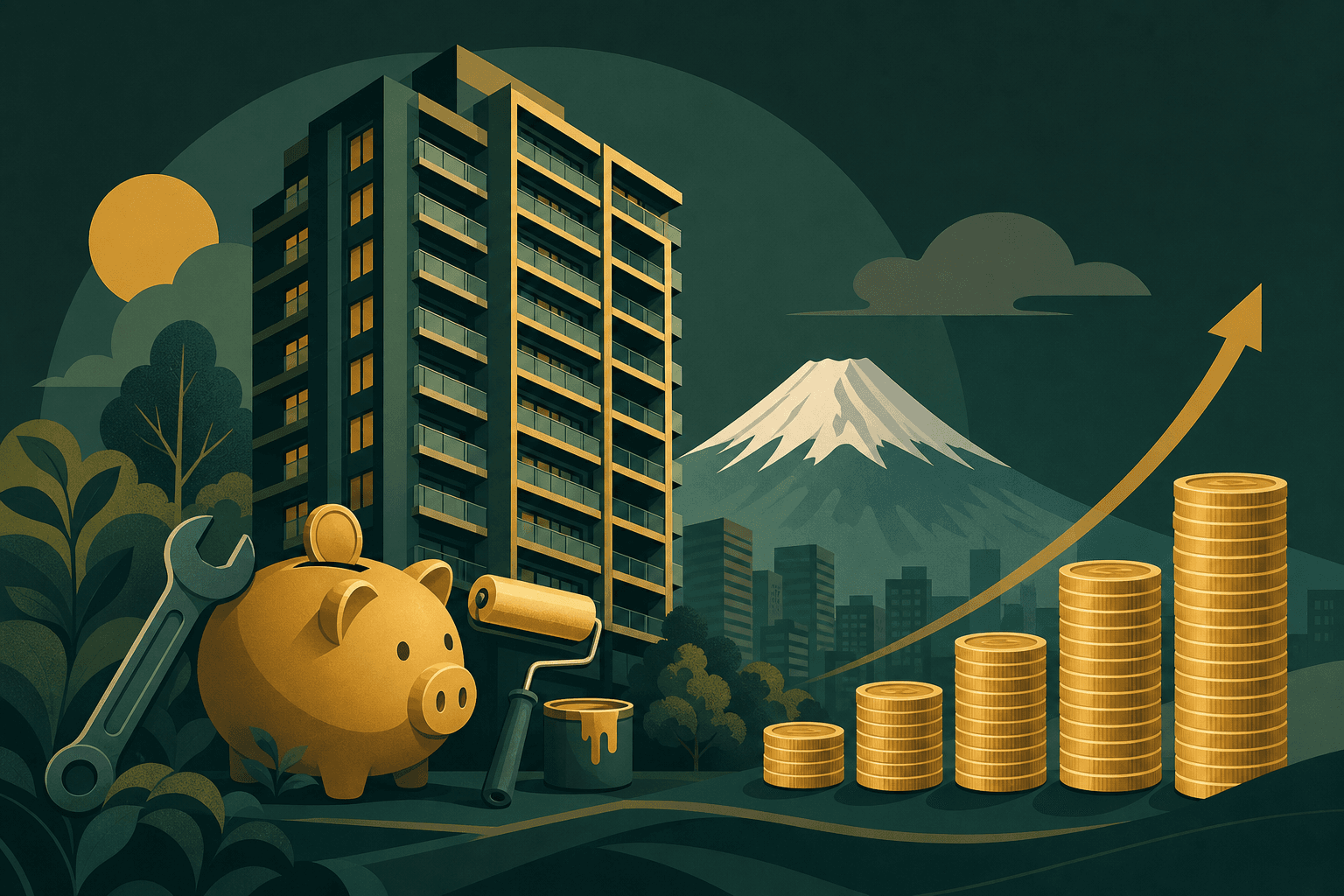
🔑 Key Takeaway: A Japanese condo's management fee (管理費) covers day-to-day building operations, while the repair reserve fund (修繕積立金) saves for big future repairs. The reserve is the one that catches buyers out: it almost always rises over time (often on a staged schedule), and an underfunded reserve can trigger a one-time special assessment (一時金) of hundreds of thousands of yen. Checking the building's reserve health is one of the most important — and most overlooked — due-diligence steps.
If you buy a condominium (マンション) in Japan, two monthly charges follow you for as long as you own it: the management fee and the repair reserve. They're fixed by the building's management association, not negotiable, and they can quietly make or break the economics of an otherwise good purchase. This guide explains how each works and exactly what to check before you buy.
This is a deep dive on a topic introduced in our Japan property running costs guide — read that for the full picture of recurring costs.
Management Fee (管理費 / Kanrihi)
The management fee funds the ongoing operation of the building's shared areas. It is consumed each month — it does not accumulate.
What it typically covers:
- Common-area cleaning and the building manager's (管理人) salary
- Elevator maintenance and shared utilities (hallway lighting, water pumps)
- Fire-safety equipment inspection and legal compliance checks
- Administration by the management company (管理会社)
- For premium buildings: concierge, security, gym, guest rooms, lounges
Typical ranges:
| Building type | Monthly management fee |
|---|---|
| Standard mid-size condo | ¥8,000–¥25,000 |
| Tower / luxury condo (タワーマンション) | ¥20,000–¥40,000+ |
Fees are generally proportional to your unit's exclusive floor area (専有面積). Older buildings with few units often have higher per-unit fees because fixed costs are shared among fewer owners.
Repair Reserve Fund (修繕積立金 / Shuzen Tsumitatekin)
The repair reserve is a mandatory monthly contribution that accumulates to pay for periodic large-scale repairs (大規模修繕) — exterior painting and waterproofing, roof and facade work, elevator replacement, plumbing renewal, and structural maintenance. These major cycles typically occur roughly every 12–15 years.
Typical range: ¥5,000–¥20,000 per month, rising with building age.
Why the reserve almost always rises
Most Japanese condos use a staged-increase plan (段階増額方式 / dankai zōgaku hōshiki): the monthly contribution starts low when the building is new and steps up at predetermined intervals (often every ~5 years) as major repairs approach.
This has a critical implication for buyers: a low repair reserve today is not necessarily good news. It may simply mean the next scheduled increase — or a shortfall — is ahead of you.
A minority of buildings use an equalized plan (均等積立方式), where contributions are higher but flat from the start. These are generally healthier for budgeting.
Special assessments (一時金): the nasty surprise
If the accumulated reserve is insufficient when a major repair comes due, the management association can levy a one-time special assessment (一時金) on every owner — commonly ¥500,000 or more per unit. Buying into a building with an upcoming repair and a thin reserve means you could inherit this bill shortly after purchase.
The Single Most Important Document: The Long-Term Repair Plan
Before buying, obtain and review the long-term repair plan (長期修繕計画 / chōki shuzen keikaku). It shows the schedule of planned major repairs and the projected reserve balance over 20–30 years. Read it alongside the management association's accounts.
Red flags to check
- Thin reserve balance relative to the building's age and the next scheduled repair
- Steep upcoming staged increases that will raise your monthly cost
- A major repair due soon with insufficient funds (special-assessment risk)
- High delinquency — unpaid fees by other owners (管理費等の滞納) erode the fund
- No or outdated long-term repair plan — a sign of weak management
- Very low fees in an old building — often a warning, not a bargain
Green flags
- An equalized contribution plan or a reserve that tracks the plan
- A recently completed major repair with a healthy remaining balance
- Active, well-documented management association (管理組合) with regular general meetings (総会)
- Low or zero fee delinquency
Can These Fees Be Negotiated or Changed?
No — not individually. Management fees and repair reserves are set by the management association (管理組合) through a resolution at the owners' general meeting (総会). Every owner pays the same rate per square meter, and changes require a vote of the owners. You cannot negotiate your own rate as a buyer.
What you can do is know the numbers before you offer — they're fully knowable, so there's no excuse for being surprised after purchase. Make this part of your due-diligence checklist.
How This Affects Your Investment Returns
For an investor, management fee + repair reserve are pure costs that reduce net yield. Two units at the same price and rent can deliver very different returns if one building has double the monthly fees. And because the reserve rises over time, a yield calculated on today's fees can erode over a long hold. Factor the staged-increase schedule into your model — see our rental yields by area guide and cap rate & yield metrics guide.
What Non-Resident Owners Should Know
- These fees are fixed in yen and due monthly regardless of whether the unit is occupied or you're in the country.
- Most non-resident owners pay them via automatic bank debit from a Japanese account, or have a property manager handle them.
- Because they're fixed costs, they eat a larger share of yield on lower-priced regional units than on premium Tokyo ones.
Frequently Asked Questions
What is the difference between management fee and repair reserve in Japan?
The management fee (管理費) pays for day-to-day building operations — cleaning, the building manager, elevator upkeep, shared utilities, and administration — and is consumed each month. The repair reserve fund (修繕積立金) accumulates to pay for periodic large-scale repairs like exterior waterproofing and elevator replacement, which occur roughly every 12–15 years.
Why does the repair reserve fund increase over time?
Most Japanese condos use a staged-increase plan (段階増額方式) that starts low when the building is new and steps up at set intervals as major repairs approach. So a low reserve today often signals future increases rather than a bargain. Always review the long-term repair plan to see the scheduled increases.
What is a special assessment (一時金) and how can I avoid one?
A special assessment is a one-time charge levied on all owners when the repair reserve is insufficient for an upcoming major repair — often ¥500,000 or more per unit. Avoid inheriting one by reviewing the long-term repair plan, the reserve balance, and the timing of the next major repair before you buy.
Can I negotiate condo management fees in Japan?
No. Management fees and repair reserves are set by the building's management association (管理組合) via owner resolution and apply equally to all units per square meter. Individual buyers cannot negotiate them — but you can and should confirm the exact amounts and any planned increases before making an offer.
What documents should I review before buying a Japanese condo?
At minimum: the long-term repair plan (長期修繕計画), the management association's accounts and minutes (especially the reserve balance and any fee delinquency), the current management fee and repair reserve amounts, and the schedule of any staged increases. These reveal the building's financial health and special-assessment risk.
Related Articles
- Japan Property Running Costs: Monthly & Annual →
- Japan Fixed Asset Tax Explained for Foreign Owners →
- Japan Property Due Diligence Checklist →
- Japan Rental Yields by Area →
- Non-Resident Property Management & Banking →
- Japan Condominium Law Changes 2026 →
Disclaimer
This article is for informational purposes only and does not constitute financial, legal, or investment advice. Management fees, repair reserve contributions, increase schedules, and special assessments are set by each building's management association and vary widely. Figures are general ranges as of June 2026. Always review the specific building's current fees, accounts, and long-term repair plan before purchase, and consult qualified professionals.