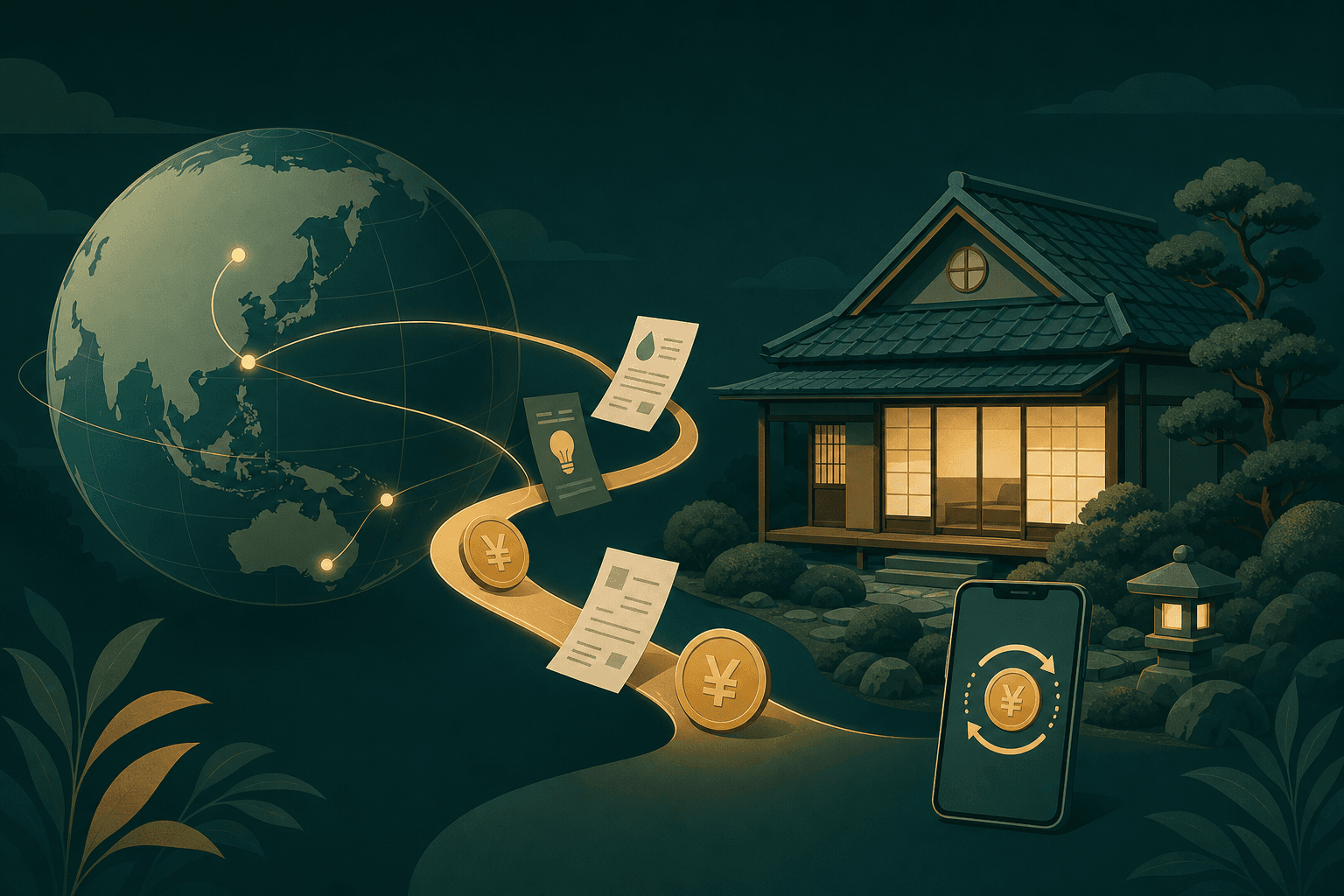
🔑 Key Takeaway: The challenge for overseas owners isn't the cost of Japanese bills — it's the plumbing of paying them. Property tax requires a mandatory tax representative (納税管理人); recurring bills (utilities, management fees, repair reserve) are best put on auto-debit from a Japanese account; and you fund that account with periodic, batched international transfers to minimize FX and wire costs. Set this up once and it largely runs itself.
Once you own Japanese property and live abroad, you face a steady drip of yen-denominated bills — fixed asset tax, condo management fees, the repair reserve, utilities, insurance, and management-company fees. None are individually difficult, but Japan's payment infrastructure assumes a local address and a Japanese bank account. This guide shows how to handle it all reliably from overseas.
It builds on our running costs guide and non-resident property management guide.
The Core Problem: Bills Assume a Japanese Address
Most Japanese billing — tax notices, utility statements, association notices — is mailed to a Japanese address and paid through Japanese channels (bank debit, convenience store, local payment apps). As a non-resident, you need a setup that bridges this gap. There are three pillars.
Pillar 1 — Property Tax: The Tax Representative (納税管理人)
For fixed asset tax and city planning tax, non-residents are legally required to appoint a tax representative (納税管理人 / nōzei kanrinin):
- The representative has a Japanese address, receives your tax notice (納税通知書), and pays the four annual installments on your behalf.
- It is mandatory, not optional, for non-residents owning taxable property.
- Common choices: your judicial scrivener (司法書士), tax accountant (税理士), property management company, or a trusted individual in Japan.
- Annual fees typically run ¥30,000–¥100,000.
You then reimburse the representative (or pre-fund them) for the tax paid. See how the tax itself is calculated in our fixed asset tax guide.
Why it matters: Missed property tax accrues delinquency charges and can ultimately lead to a tax lien (差押え). The representative system exists precisely so that overseas owners don't miss payments.
Pillar 2 — Recurring Bills: Auto-Debit From a Japanese Account
For management fees, the repair reserve, utilities, and insurance, the cleanest solution is a Japanese bank account with automatic debit (口座振替) set up for each biller:
- Condo management fee + repair reserve are usually collected by monthly auto-debit by the management company — set this up at handover.
- Utilities (electricity, gas, water) and internet can be placed on auto-debit or credit-card billing.
- Insurance premiums can be paid annually or in multi-year lump sums (often cheaper per year).
Keeping a Japanese bank account is therefore extremely valuable for non-resident owners. Options that foreign residents commonly retain include SMBC Prestia (English support) and Sony Bank (multi-currency). Note that opening or keeping an account as a non-resident can be restrictive — see the account section of our banks for foreigners guide.
If you can't maintain a Japanese account, a property management company can pay bills on your behalf and bill you periodically — the simplest (if not the cheapest) route.
Pillar 3 — Funding the Account: Smart International Transfers
You keep the Japanese account topped up via international transfers. The goal is to minimize FX spread and per-transfer fees:
- Batch transfers. Send larger amounts a few times a year rather than many small ones — each wire carries fixed costs.
- Watch the FX spread, not just the fee. Traditional bank wires often hide cost in a poor exchange rate. Specialist FX/transfer services and multi-currency accounts (e.g., Sony Bank, or international fintech transfer providers) usually beat bank telegraphic transfers.
- Keep a buffer. Maintain a balance covering several months of fees plus the next tax installment, so a delayed transfer never causes a missed auto-debit.
- Mind documentation. Large inbound transfers may prompt source-of-funds questions; keep records. See sending money to Japan.
For owners earning foreign-currency income, a multi-currency account lets you convert on favorable days and hold yen ready for bills — see our Sony Bank guide.
Putting It Together: A Reliable Non-Resident Payment Stack
| Bill | Best mechanism | Who handles it |
|---|---|---|
| Fixed asset / city planning tax | Tax representative (納税管理人) | 司法書士 / 税理士 / manager |
| Management fee + repair reserve | Auto-debit (口座振替) | Japanese bank account |
| Utilities & internet | Auto-debit / credit card | Japanese bank/card |
| Insurance | Annual / multi-year lump sum | Japanese bank account |
| Management-company fee | Auto-debit or invoice | Property manager |
| Funding | Batched international transfers | You + FX provider |
Set up once at handover, this stack runs with minimal ongoing effort — typically just topping up the account a few times a year and reconciling the tax representative's payments.
If You Earn Rental Income
If your property is tenanted, money flows both ways: rent comes in (often collected by your management company), bills go out, and you'll likely file a Japanese tax return. Non-resident rental income is subject to 20.42% withholding, with a tax-accountant filing to deduct expenses and reclaim over-withheld amounts. When it's time to move profits home, see our guide to repatriating rental income and sale proceeds.
Frequently Asked Questions
How do non-residents pay property tax in Japan?
Non-residents must appoint a tax representative (納税管理人) — a person or firm with a Japanese address who receives the tax notice and pays the four annual fixed asset tax installments on the owner's behalf. The owner reimburses or pre-funds the representative. This is a legal requirement for non-residents who own taxable Japanese property.
Can I pay Japanese utilities and management fees from overseas?
Yes — the cleanest way is to set up automatic bank debit (口座振替) from a Japanese bank account for utilities, management fees, and the repair reserve, then fund that account via periodic international transfers. If you can't keep a Japanese account, a property management company can pay the bills and invoice you.
Do I need a Japanese bank account as a non-resident owner?
It's not strictly mandatory for every bill, but it makes paying recurring charges far easier through auto-debit. Keeping an account (such as one opened while resident) is highly valuable. If you can't maintain one, rely on a tax representative for taxes and a property manager for other bills.
What's the cheapest way to send money to Japan for property bills?
Batch larger transfers a few times a year to spread fixed wire costs, and prioritize the exchange-rate spread over the headline fee — specialist FX/transfer services and multi-currency accounts typically beat traditional bank telegraphic transfers. Keep a buffer in the Japanese account so a delayed transfer never causes a missed payment.
What happens if I miss a Japanese property tax payment from abroad?
Unpaid fixed asset tax accrues delinquency charges and, after extended non-payment, can lead to a tax lien (差押え) and ultimately forced auction. The obligation stays attached to the registered owner. The tax representative system exists to prevent this — appoint one and keep them funded.
Related Articles
- Japan Property Running Costs: Monthly & Annual →
- Japan Fixed Asset Tax Explained for Foreign Owners →
- Non-Resident Property Management & Banking →
- Repatriating Rental Income & Sale Proceeds Out of Japan →
- How to Send Money to Japan for Property Purchase →
- Sony Bank Mortgage & Multi-Currency Guide →
Disclaimer
This article is for informational purposes only and does not constitute financial, legal, or tax advice. Payment systems, bank account eligibility for non-residents, tax representative requirements, and transfer/FX costs vary by provider and change over time. Figures are general estimates as of June 2026. Consult a qualified Japanese tax accountant (税理士), judicial scrivener (司法書士), and your bank for guidance specific to your situation.