📋 April 2026 Update: This guide has been reviewed and updated to reflect current 2026 rules and costs.
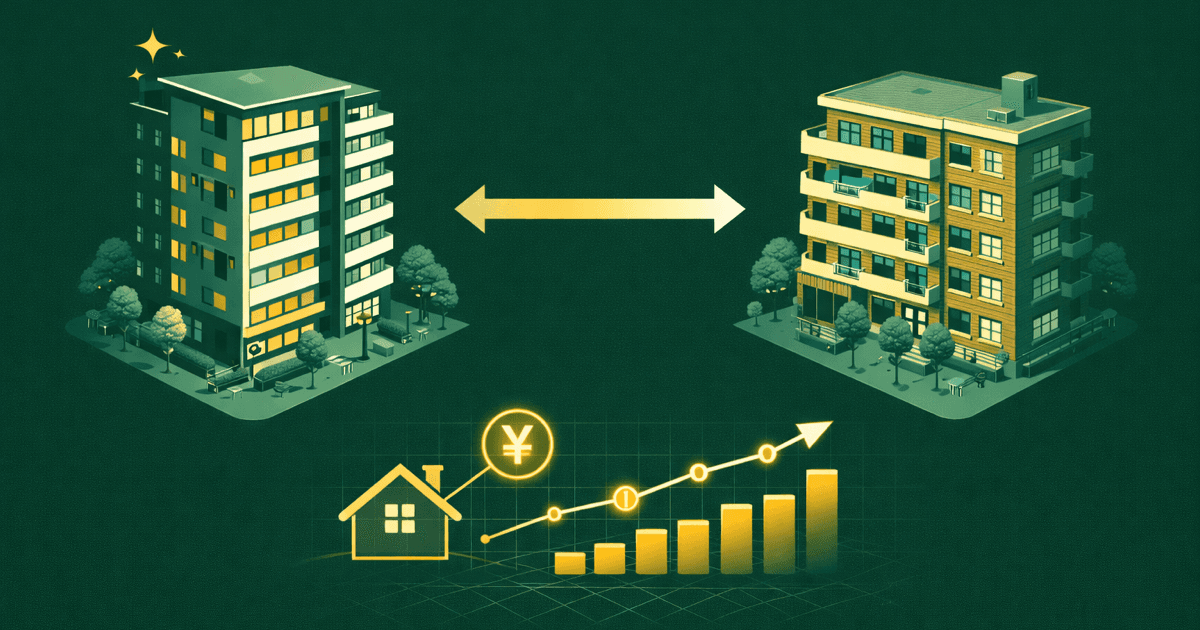
For most foreign investors, used (resale) properties are the better investment. They offer higher yields, lower entry prices, and significant tax depreciation benefits. New-build condos cost 20–30% more and depreciate immediately after purchase. This data-driven comparison uses MLIT government transaction records to show the real numbers.
Key Takeaways
- New-build condos in Tokyo carry a 20–40% price premium over comparable resale units
- Used properties typically deliver 1–2 percentage points higher gross yields
- Japanese buildings depreciate on a fixed schedule regardless of actual condition — this creates tax advantages for used property investors
- The 1981 earthquake code revision is the critical dividing line for building quality
- Most experienced foreign investors in Japan buy used (resale) properties for income investment
Japan's Unique New vs Used Dynamic
Japan's property market has characteristics that make the new-vs-used decision different from Western markets:
- Cultural preference for new: Japanese domestic buyers historically prefer new construction, creating a price premium that depreciates immediately after purchase
- Fixed depreciation schedules: Buildings depreciate on tax schedules (e.g., 47 years for reinforced concrete) regardless of actual condition, creating tax deduction opportunities
- High construction standards: Even older buildings are often well-maintained through mandatory management associations
- Transparent transaction data: MLIT records allow direct comparison of new and used transaction prices in the same area
Price Comparison: The New-Build Premium
Based on MLIT condominium transaction data for central Tokyo:
| Building Age | Median Price/m² | Premium vs. 10-Year-Old |
|---|---|---|
| New (0 years) | ~¥1,500,000 | +35% |
| 5 years | ~¥1,300,000 | +17% |
| 10 years | ~¥1,110,000 | Baseline |
| 15 years | ~¥1,000,000 | –10% |
| 20 years | ~¥900,000 | –19% |
| 30 years | ~¥700,000 | –37% |
| 40+ years | ~¥550,000 | –50% |
The new-build premium is most pronounced in the first 5 years, then depreciation follows a more gradual curve. Properties 10–20 years old occupy a "sweet spot" where the initial premium has been shed but the building remains modern and well-maintained.
💡 Verify current price levels for your target area using our location analysis pages
Depreciation and Tax Benefits
How Japanese Depreciation Works
Japanese tax law assigns fixed useful lives to buildings based on construction type:
| Construction Type | Useful Life | Annual Depreciation Rate |
|---|---|---|
| Reinforced concrete (RC/SRC) | 47 years | 2.1% |
| Steel frame | 34 years | 2.9% |
| Wood frame | 22 years | 4.5% |
The remaining depreciable life at purchase is calculated as:
Remaining life = (Useful life – Building age) + (Building age × 20%)
Why This Matters for Investors
A used building has a shorter remaining depreciable life, which means larger annual depreciation deductions against rental income. This is a significant tax advantage:
Example: ¥50M RC condominium (building value portion: ¥30M)
| Scenario | Building Age | Remaining Life | Annual Depreciation |
|---|---|---|---|
| New build | 0 years | 47 years | ¥638,000 |
| 10 years old | 10 years | 39 years | ¥769,000 |
| 20 years old | 20 years | 31 years | ¥967,000 |
| 30 years old | 30 years | 23 years | ¥1,304,000 |
The 30-year-old building generates more than double the annual depreciation deduction of a new build — reducing taxable rental income substantially.
For non-resident investors paying the 20.42% withholding tax on rental income, these deductions (claimed via tax return filing) can significantly reduce your effective tax rate.
Rental Yield Comparison
Lower purchase prices for used properties directly translate to higher yields:
| Property Profile | Purchase Price | Monthly Rent | Gross Yield |
|---|---|---|---|
| New, 25 m², Shinjuku | ¥40,000,000 | ¥135,000 | 4.1% |
| 10-year, 25 m², Shinjuku | ¥30,000,000 | ¥120,000 | 4.8% |
| 20-year, 25 m², Shinjuku | ¥24,000,000 | ¥105,000 | 5.3% |
| New, 30 m², Osaka Umeda | ¥22,000,000 | ¥95,000 | 5.2% |
| 15-year, 30 m², Osaka Umeda | ¥16,000,000 | ¥82,000 | 6.2% |
Rents decrease with building age, but not nearly as much as purchase prices. A 20-year-old building might sell for 40% less than a new equivalent, but its rent is only 15–20% lower — the yield premium for used properties follows from this asymmetry.
Comprehensive Comparison
| Factor | New Build | Used (Resale) |
|---|---|---|
| Purchase price | Higher (20–40% premium) | Lower |
| Gross yield | 3.0–4.5% | 4.5–7.0% |
| Maintenance costs | Low initially | Varies; check building condition |
| Depreciation benefit | Lower annual deduction | Higher annual deduction |
| Earthquake standard | Current code | Verify: pre or post 1981 |
| Management fees | Set by developer (may increase) | Established track record |
| Repair reserve | Low initially (rises over time) | Higher but predictable |
| Negotiation margin | Minimal (0–2%) | Moderate (3–5%) |
| Warranty | 10-year structural warranty | No warranty (as-is) |
| Tenant appeal | Premium — attracts higher-end tenants | Good — location matters more than age |
| Agent fee | Often none (buy direct from developer) | Standard 3% + ¥66,000 |
| Capital appreciation | Immediate depreciation after purchase | More stable (premium already shed) |
| Liquidity | Good | Good (larger resale market) |
The 1981 Earthquake Code: The Critical Dividing Line
Japan revised its Building Standards Act (建築基準法) in June 1981, introducing the New Earthquake Resistance Standard (shin-taishin). This is the most important consideration when evaluating older buildings:
Pre-1981 (旧耐震)
- Designed to withstand intensity 5 earthquakes (moderate)
- May not survive major earthquakes without damage
- Mortgage financing often unavailable or restricted
- Insurance may be more expensive or limited
- Resale value significantly discounted
Post-1981 (新耐震)
- Designed to withstand intensity 6–7 earthquakes (severe)
- Most have performed well in actual earthquakes (2011 Tohoku, 2016 Kumamoto)
- Full mortgage financing available
- Standard insurance access
- Mainstream resale market
Recommendation: Unless you have specific expertise, limit your search to post-1981 buildings. The price discount for pre-1981 stock rarely compensates for the risk and financing limitations.
Some pre-1981 buildings have been retrofitted (taishin hoshu) to meet current standards. Verify with documentation.
Building Condition Assessment
For used properties, evaluate:
Management Association Health
- Repair reserve fund balance: Is it sufficient for the next planned major repair?
- Long-term repair plan: Does one exist? When was it last updated?
- Fee delinquency rate: High delinquency (>10%) is a red flag
- Meeting attendance: Low attendance suggests disengaged owners
- Owner-occupier ratio: Higher ratios generally correlate with better maintenance
Physical Condition
- Common areas: Lobby, hallways, elevator condition indicate management quality
- Exterior: Cracks, water staining, balcony condition
- Plumbing: Older buildings may need pipe replacement (major expense)
- Electrical: Panel capacity, wiring condition
- Earthquake resistance: Confirm post-1981 or retrofitted status
Documents to Request
- Long-term repair plan (choki shuzen keikaku)
- Repair reserve fund balance statement
- Recent management association meeting minutes
- Building inspection reports
- Management fee and reserve payment history
Strategy by Investor Type
Yield-Focused Investor
Best choice: Used property, 10–25 years old
- Lower purchase price maximizes yield
- Depreciation deductions reduce tax burden
- Established buildings have predictable costs
- Target: post-1981 RC buildings with well-funded repair reserves
Capital Appreciation Investor
Best choice: New or near-new property in development areas
- New buildings in redeveloping areas capture the most upside
- Premium location + new building = strongest appreciation potential
- Accept lower current yield for growth
- Target: areas with major infrastructure projects (Shibuya, Toranomon, Osaka Umeda)
First-Time Japan Investor
Best choice: Used property, 5–15 years old
- Balances yield and modern amenities
- Enough transaction history to evaluate the building
- Management track record is visible
- Lower capital at risk while learning the market
Tax-Optimization Investor
Best choice: Used property, 25–40 years old (post-1981)
- Maximum depreciation deductions
- Lowest purchase prices for given locations
- Requires careful building selection (condition varies more)
- Best suited for experienced investors with local advisory support
Due Diligence Checklist for Used Properties
Purchasing used (中古) property in Japan requires careful inspection that goes beyond what many foreign buyers are accustomed to. The following items are frequently overlooked.
For Houses (一戸建て / Ikkodate)
Check 1: Rebuilding Prohibited Status (再建築不可 / Saiken-chiku Fuka)
Some properties — often attractively priced — are located on land where rebuilding is legally prohibited. This means if the building is destroyed by earthquake, fire, or typhoon, it cannot be rebuilt.
This status typically results from the property not meeting current building standards for road frontage (接道義務 / setsudo gimu). The land must have at least 2 meters of frontage on a road that is at least 4 meters wide.
These properties may appear to be bargains, but they carry significant risk:
- No rebuilding after disaster
- Extremely difficult to resell
- Mortgage financing is typically unavailable
Always confirm with the agent: 「この物件は再建築可能ですか?」 (Is this property eligible for rebuilding?)
Check 2: Defect Liability (契約不適合責任 / Keiyaku Futekigo Sekinin)
Japan's Civil Code requires sellers to take responsibility for undisclosed defects. However, the scope varies significantly by seller type:
| Seller Type | Liability Period | Coverage |
|---|---|---|
| Licensed dealer (業者) | Minimum 2 years | Structural defects, leaks, termites, etc. |
| Private individual (個人) | Often 0-3 months, or waived entirely | Limited or none |
When buying from a private seller, the contract may include a clause waiving all defect liability (瑕疵担保免責). This means post-purchase repairs are entirely the buyer's responsibility.
Recommendation: For foreign buyers unfamiliar with Japanese construction standards, purchasing from a licensed dealer provides significantly stronger protection.
For Condos (マンション / Mansion)
Check 3: Repair History and Reserve Fund (修繕履歴・修繕積立金)
This is the single most important due diligence item for used condos. Request:
-
修繕履歴 (Shuzen Rireki): Complete history of past repairs. Major condos should have undergone large-scale repair (大規模修繕) approximately every 12-15 years.
-
長期修繕計画 (Choki Shuzen Keikaku): The long-term repair plan. Verify it exists and is up to date.
-
修繕積立金の残高 (Shuzen Tsumitatekin no Zandaka): The current balance of the repair reserve fund. Compare this against the planned expenditures.
Red flags:
- No large-scale repair has ever been done on a building older than 15 years
- Repair reserve fund is significantly below planned needs
- Monthly repair reserve contributions (修繕積立金) are unusually low (under ¥200/m²/month suggests underfunding)
- No long-term repair plan exists
Insufficient reserves can lead to:
- Special assessments (一時金 / ichijikin) of ¥500,000-¥2,000,000+ per unit
- Inability to perform necessary repairs
- Accelerated depreciation of the building and your investment
For recent condo transaction prices and trends in your target area, check JRE's MLIT-based location data.
For details on Japan's 2026 condominium law changes, see our Condominium Law Changes Guide.
Frequently Asked Questions
Do Japanese tenants prefer new buildings?
Japanese tenants value cleanliness and good maintenance over building age. A well-maintained 20-year-old building in a good location will attract quality tenants. Building age matters less than station proximity, floor plan, and management quality.
Will a used building need expensive repairs?
Potentially. The key is evaluating the long-term repair plan and reserve fund before purchasing. Buildings with well-funded reserves and a current repair plan are lower risk. Avoid buildings where the reserve fund is insufficient for planned repairs — this signals future special assessments.
Can I get a mortgage for a used property?
Yes, with conditions. Most banks will finance post-1981 buildings. Some banks have maximum building age limits (e.g., building age + loan term must not exceed 50–60 years). Pre-1981 buildings are difficult to finance.
How do I verify the earthquake resistance standard?
The building's construction completion date (not the permit date) determines which standard applies. Your agent or judicial scrivener can confirm this from the building registry. For retrofitted buildings, request the earthquake resistance evaluation certificate (taishin shindan).
Is the resale market liquid enough for foreign investors?
The Japanese resale condominium market is large and active — particularly in Tokyo, Osaka, and Fukuoka. Resale transactions outnumber new-build transactions significantly. Liquidity is not a concern in major urban areas.
Explore Transaction Data
Compare new and used property prices in your target areas:
Disclaimer
This article provides general market analysis and should not be considered investment advice. Property values, rental yields, and tax regulations change. Always conduct independent due diligence and consult with qualified professionals before making investment decisions.