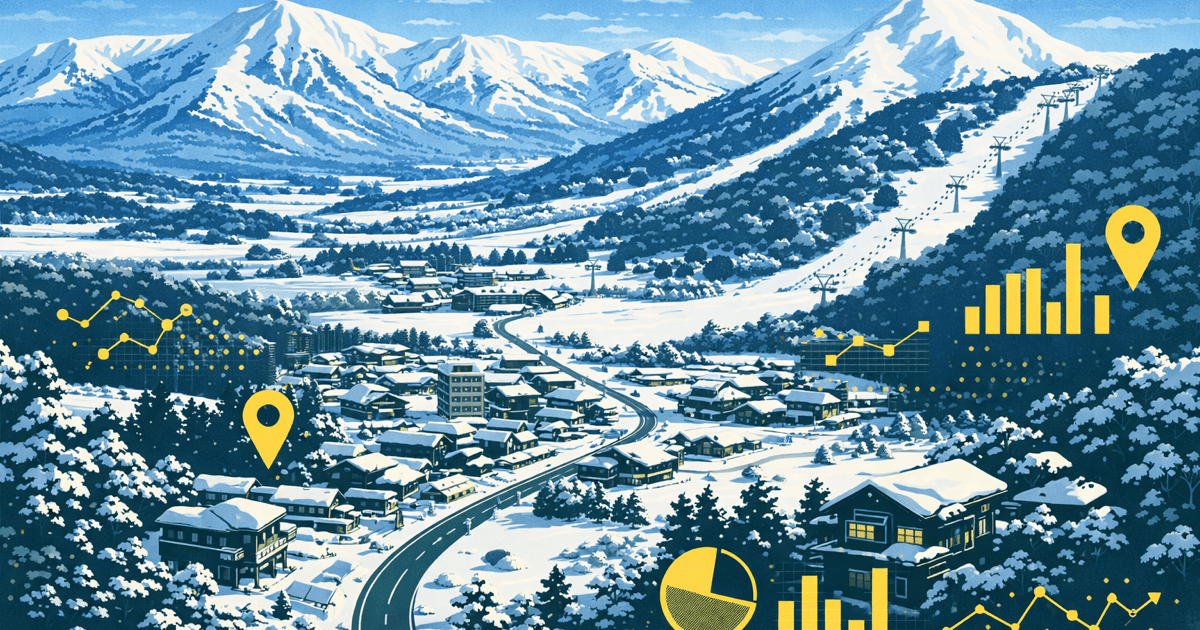
Everyone ranks akiya areas by "vibe" or "lifestyle." We ranked them by government data. Using MLIT's 2026 official land prices and actual transaction records, we divided Japan's akiya regions into two tiers: areas where vacant houses sit on appreciating land (the opportunity zone), and areas where both houses AND land are declining (the risk zone). Here's the data-driven guide.
Japan has an estimated 9 million vacant houses (空き家), and that number is rising. But the investment case for buying one depends almost entirely on where that house sits. A ¥1M akiya on land appreciating at 12% per year is a fundamentally different proposition from a free house on land that loses value every year. The difference isn't opinion — it's in the government data.
Before diving into the rankings: if you're new to akiya, start with our true cost analysis — the ¥500,000 headline price is not the real cost. For a comparison with urban condos, see Akiya vs Tokyo Condo. For land price trends across all high-vacancy regions, see our akiya land price map.
How We Ranked — Methodology
We scored akiya regions on four factors, each drawn from verifiable data sources:
| Factor | Weight | Data Source | Why It Matters |
|---|---|---|---|
| Land price trend (YoY) | 30% | MLIT 2026 Official Land Price Survey (公示地価) | Rising land = your asset appreciates over time |
| Transaction volume | 20% | MLIT Real Estate Transaction Records (取引価格情報) | Active market = you can sell later if needed |
| Foreign buyer accessibility | 25% | JRE assessment (English services, airport access, international community) | Practical ability to buy, manage, and rent |
| Tourism/economic driver | 25% | Tourism statistics + qualitative assessment | External demand supports property values long-term |
We didn't include "charm" or "atmosphere" — those are subjective. We focused on what affects your investment outcome. Every data point in the land price and transaction columns comes from Japan's Ministry of Land, Infrastructure, Transport and Tourism (MLIT), the same data Japanese institutional investors use.
For the full 2026 official land price breakdown, see our complete MLIT data analysis.
Top Tier — Akiya Areas Where Land Is Rising
These areas have vacant houses available AND land prices that are appreciating. Foreign buyer infrastructure exists. The combination of cheap housing stock on rising land is the core opportunity.
| Rank | Area | Land Price YoY (2026) | Akiya Available? | Foreign Accessibility | Best For |
|---|---|---|---|---|---|
| 1 | Kutchan / Niseko (Hokkaido) | +12.32% | Yes (surrounding areas) | High | Ski resort investment, vacation rental |
| 2 | Hakuba (Nagano) | +26.9% | Yes (village outskirts) | High | Ski/outdoor resort, land banking |
| 3 | Okinawa (Chatan, Onna, Naha) | +6.52% (pref avg) | Yes (inland areas) | High | Beach resort, vacation rental |
| 4 | Karuizawa (Nagano) | +9.83% | Limited | Medium | Weekend retreat, high-end lifestyle |
| 5 | Chitose / Tomakomai (Hokkaido) | +44.1% | Yes | Medium | Logistics/semiconductor proximity |
| 6 | Fukuoka suburbs | +3–5% | Yes | Medium-High | Urban-adjacent lifestyle |
1. Kutchan / Niseko — The Gold Standard
The gold standard for akiya-meets-appreciation. Surrounding areas still have affordable vacant properties while prime Hirafu land trades at ¥189,000/m² (+21.9% at the resort core). The town-wide average across 4 MLIT survey points is ¥120,750/m² at +12.32%. The gap between a ¥2M akiya 10km from the lifts and ¥130M development land in Hanazono is enormous — but the land under both is rising.
English-speaking agents, property managers, and legal services are well-established. The international community (primarily Australian, Southeast Asian, and Hong Kong investors) has been active here for over a decade. This is not a speculative frontier — it's a maturing resort market with deep liquidity by Japanese rural standards.
Land that cost ¥18,000/m² in 2016 is now government-appraised at ¥189,000/m² — a 950% increase in 10 years. Even during COVID in 2021, prices held flat. They never declined. For the full 10-year data, see our Niseko & Kutchan land price analysis.
See actual transaction data: Kutchan → | Niseko Town →
View real transaction prices, price trends, and investment analysis for Kutchan / Niseko based on MLIT government data.
Explore Kutchan / Niseko Data →2. Hakuba — Japan's Fastest-Rising Ski Resort
Japan's second ski boom town — and in 2026, the fastest rising. Land prices jumped +26.9% on average across 3 MLIT survey points, with the top point hitting +35.2%. That's faster than Niseko. The international community (primarily Australian and North American) has created a self-sustaining ecosystem of English-speaking real estate agents, property managers, and hospitality businesses.
Akiya exist in the surrounding villages (Otari, Omachi, Hakuba outskirts) at a fraction of resort-core prices, but they're being absorbed quickly. Five years ago, you could find a habitable house within 15 minutes of the ski lifts for under ¥5M. That window is closing.
Unlike Niseko, Hakuba benefits from proximity to Nagano city (40 minutes) and relatively easy access from Tokyo via Hokuriku Shinkansen to Nagano Station. Summer outdoor tourism (hiking, mountain biking, rafting) provides year-round demand — not just winter.
See Hakuba transaction data: Hakuba →
View real transaction prices, price trends, and investment analysis for Hakuba based on MLIT government data.
Explore Hakuba Data →3. Okinawa Islands — Subtropical Demand Engine
Subtropical climate, year-round tourism, and the US military presence create sustained property demand that most Japanese rural areas simply don't have. The prefecture-wide average land price increase was +6.52% in 2026 — but the resort areas significantly outperformed.
| Area | YoY Change | Price/m² | Driver |
|---|---|---|---|
| Onna / West Coast | +8.8% | ¥62,000 | Resort hotel development |
| Chatan / American Village | +5.7% | ¥185,000 | US military + tourism |
| Miyakojima | +6.5% | ¥82,000 | Beach tourism boom |
| Ishigaki | +5.6% | ¥95,000 | Airport expansion effect |
| Naha / Kokusai | +5.1% | ¥520,000 | Urban commercial core |
Inland akiya are significantly cheaper than coastal resort properties. Chatan and the American Village area have the highest foreign-buyer infrastructure outside Tokyo — English is widely spoken, and the US military community creates baseline demand for rental properties.
See actual transaction data: Chatan / American Village → | Onna / West Coast → | Ishigaki → | Miyakojima → | Naha →
4. Karuizawa — Tokyo's Weekend Retreat
Karuizawa has been Tokyo's premium mountain retreat for over a century. Land prices rose +9.83% across 11 MLIT survey points in 2026 — a large and reliable sample. The average price of ¥113,506/m² reflects the premium: this is not cheap rural Japan, it's established resort real estate.
Akiya availability is more limited here than in other Top Tier areas — Karuizawa's market is well-developed, and vacant properties get absorbed quickly by Tokyo buyers. When they do appear, expect renovation-ready houses in the ¥10–30M range, not the ¥1–5M bargains found in deeper rural areas. The investment case rests on Tokyo proximity (70 minutes by Shinkansen) and consistent demand from Japan's wealthiest demographic.
5. Chitose / Tomakomai — The Semiconductor Bet
The outlier on this list. Chitose recorded Japan's highest land price increase in 2026: +44.1%. The driver is Rapidus — Japan's national semiconductor project — which is building a next-generation chip fabrication plant in the city, backed by billions in government investment.
Akiya exist in surrounding areas. The investment thesis here is not tourism or lifestyle — it's industrial proximity. Worker housing demand, logistics facilities, and commercial services are all expanding rapidly. New Chitose Airport provides excellent connectivity. If the semiconductor thesis holds (and government commitment suggests it will), land here has structural tailwinds for the next decade.
The risk: this is a single-industry bet. If Rapidus delays or scales back, the growth story weakens. Diversify accordingly.
6. Fukuoka Suburbs — Urban-Adjacent Opportunity
Fukuoka is Japan's fastest-growing major city. The Tenjin Big Bang redevelopment and Hakata Station expansion are driving 6%+ annual land price growth in the city center. Suburban areas (Itoshima, Kasuya, Munakata) are seeing 3–5% growth with significantly more akiya availability.
The foreign buyer infrastructure is strong by Japanese standards — Fukuoka has an established international community, direct flights to major Asian cities, and a local government that actively promotes foreign investment. Compact city size means even suburban akiya are within 30–45 minutes of the urban core.
See Fukuoka area data: Tenjin / Daimyo → | Hakata →
Middle Tier — Interesting but Proceed with Caution
These areas have akiya and genuine lifestyle appeal, but the investment case is weaker. Land prices are flat to slightly rising — not clearly appreciating. Transaction volume is thin, which means exit options (selling later) are limited.
| Area | Land Price YoY (2026) | Akiya Availability | Caution |
|---|---|---|---|
| Kyoto outskirts (Ayabe, Fukuchiyama) | ~0% to +2% | Abundant | Cultural appeal but limited economic drivers |
| Nagano mountain towns (not Hakuba/Karuizawa) | Mixed | Abundant | Beautiful but remote, limited rental demand |
| Setouchi islands (Naoshima area) | Mixed | Available | Art tourism but very thin transaction market |
| Furano (Hokkaido) | +30% (single point) | Limited | Rising fast but tiny sample — could be noise |
Kyoto outskirts attract buyers who want the Kyoto brand at rural prices. The cultural cachet is real — but Ayabe and Fukuchiyama are 60–90 minutes from central Kyoto by train, and the local economy is stagnant. Tourism demand doesn't extend this far from the city center.
Nagano mountain towns (Azumino, Iiyama, Togakushi) offer stunning natural settings and abundant akiya. But without the resort infrastructure of Hakuba or Karuizawa, rental demand is seasonal at best and transaction volume is thin. You may buy easily but struggle to sell.
Setouchi islands benefit from the Naoshima art tourism phenomenon, but the market is extremely thin — a handful of transactions per year. Price discovery is unreliable, and exit liquidity is effectively zero for foreign sellers.
Furano deserves a special note: one MLIT survey point recorded +30% in 2026, sparking "next Niseko" speculation. But a single data point is not a trend. Furano lacks Niseko's 15-year track record of foreign investment infrastructure. It's worth watching, but not worth betting on yet.
These areas are worth exploring for lifestyle buyers — people who want to live in or frequently visit the property. But the investment case is weak. If you're buying here, buy for personal use, not returns. Budget for renovation AND ongoing management costs that you may never recoup through rental income or resale.
Bottom Tier — Cheap but Declining
These are the areas that viral akiya content comes from. The houses are genuinely cheap — sometimes free. But there are critical reasons why.
| Area | Land Price YoY (2026) | Akiya Rate | Population Trend | Risk Level |
|---|---|---|---|---|
| Shimane (Tsuwano etc.) | -0.46% | ~18% | Rapidly declining | High |
| Niigata (rural areas) | -0.41% | ~17% | Declining | High |
| Kagoshima (rural) | -0.36% | ~19% | Declining | High |
| Tokushima | Declining | ~21% (highest in Japan) | Declining | High |
| Wakayama | Declining | ~20% | Declining | High |
| Akita / Yamagata | Declining | ~15–18% | Fastest depopulation in Japan | Very High |
Shimane posted the worst prefecture-wide land price performance in 2026 at -0.46%, with its weakest point (Tsuwano) dropping -4.8%. Akita and Yamagata have the fastest population decline in Japan — losing residents at a rate that makes infrastructure maintenance unsustainable in many towns.
These are the areas viral "$69 house" videos come from. The houses are genuinely cheap — sometimes literally free through municipal akiya banks (空き家バンク). But there are critical reasons why:
1. Land is a depreciating asset here. You're not just buying a declining building — you're buying declining land. In a country where land historically holds value, this is the exception. Every year you hold, both the structure and the ground beneath it lose value.
2. Resale is near-impossible. If you can't sell later, your "investment" is actually a consumption expense. Transaction volume in these areas is so low that finding a buyer at any price may take years — or may never happen.
3. Renovation costs don't scale down. Fixing a roof costs the same whether the house is in Akita or Tokyo. A ¥3M renovation on a free house in a declining area is still ¥3M spent — with no prospect of recovering it through resale or rental income.
4. Infrastructure is deteriorating. Water systems, roads, public transport, medical facilities, and schools are all declining with population. Some areas are approaching the threshold where municipalities can no longer maintain basic services. Japan's government has officially designated certain zones as "depopulation areas" (過疎地域) with reduced service commitments.
We're not saying "never buy here." Some buyers find genuine fulfillment in rural restoration projects, and Japan's akiya subsidy programs (空き家対策補助金) can offset some renovation costs. But go in with open eyes: treat it as a lifestyle expense, not an investment. If your total budget for acquisition + renovation exceeds ¥5M, seriously consider whether the same money would go further in a Top Tier area where the land under your house is actually appreciating.
For detailed land price trends across every high-vacancy prefecture, see our akiya land price analysis. For the full renovation cost breakdown that turns a ¥500K house into a ¥3.5M+ project, see Are Akiya Really Cheap?.
The Data Behind the Decision — Summary Comparison
| Top Tier | Middle Tier | Bottom Tier | |
|---|---|---|---|
| Land price trend | Rising (+5% to +45%) | Flat to +2% | Declining (-0.3% to -5%) |
| Akiya availability | Limited (going fast) | Moderate | Abundant (often free) |
| Rental demand | Strong (tourism-driven) | Seasonal or weak | Very weak |
| Exit strategy | Sellable within reasonable timeframe | Difficult — thin market | Near-impossible |
| Foreign infrastructure | English services available | Limited | Almost none |
| Recommended for | Investment + lifestyle | Lifestyle only | Lifestyle only, with caution |
The pattern is clear: the cheapest akiya are in the areas with the worst fundamentals. The areas with the strongest fundamentals have akiya that are getting snapped up quickly. This is not a coincidence — it's how markets work. The question is whether you're buying based on the headline price or the underlying data.
What Should You Do Next?
If you're interested in Top Tier areas
Check actual transaction prices on JRE before making any offers. The gap between asking prices and actual transaction prices recorded by MLIT is typically 10–20%. Knowing what properties actually sold for — not what they were listed at — gives you a concrete negotiation anchor.
Explore JRE Locations — 20+ areas with government transaction data →
If you're interested in Middle Tier areas
Research extensively before committing. Visit in person at least twice, in different seasons — a mountain town in summer and winter are different realities. Budget for renovation AND ongoing management costs, and don't assume rental income will cover them. Talk to local residents, not just real estate agents.
If you're considering Bottom Tier areas
Read our due diligence guide first. Get a professional building inspection (建物状況調査, ¥50,000–100,000). Verify water, sewage, and road access BEFORE purchasing — some akiya are on private roads or aging water systems that require significant investment just to bring to habitable condition.
Japan Property Due Diligence Checklist →
Treat the total cost (acquisition + renovation + first 3 years of maintenance) as your real purchase price — see our full akiya cost breakdown for what that actually looks like, and the hidden costs of "¥0 akiya" for foreign buyers for non-resident-specific expenses (tax representative, FEFTA, 特定空家 designation). If that number exceeds what a Top Tier akiya would cost, reconsider your strategy. And before choosing between akiya and urban property, review our Akiya vs Tokyo Condo comparison.
Methodology Notes
Land price data: All YoY change figures are from the 2026 Official Land Price Survey (令和8年地価公示), published March 18, 2026 by Japan's Ministry of Land, Infrastructure, Transport and Tourism (MLIT). Survey methodology: 25,565 benchmark points nationwide, appraised by licensed real estate appraisers as of January 1, 2026.
Transaction data: Actual transaction prices referenced are from the MLIT Real Estate Transaction Price Information System (不動産取引価格情報), which compiles reported sales data from completed real estate transactions across Japan.
Akiya rates: Prefecture-level vacancy rates are from the Ministry of Internal Affairs and Communications Housing and Land Survey (住宅・土地統計調査). Municipal-level akiya rates vary significantly within prefectures.
Foreign accessibility scores: JRE's qualitative assessment based on: availability of English-speaking real estate agents and legal services, international airport accessibility, established foreign resident/investor community, and municipal government support for foreign buyers.
This ranking will be updated annually as new MLIT data is published.
Related Reading
- Pre-1981 Akiya Risk 2026: Why 60%+ Fail Modern Earthquake Code — The structural-safety filter that determines whether a Top Tier akiya is genuinely habitable
- Akiya Renovation Costs 2026: Real Examples by Region — Region-specific renovation budgets for Niseko, Hakuba, Tokushima, Wakayama, and Okinawa
- Japan's 9 Million Vacant Houses 2026: Government Data — Why akiya inventory is concentrated in Bottom Tier regions and what 2030/2040 looks like
- The Hidden Costs of "¥0 Akiya" for Foreign Buyers — Every hidden cost category, 3 real scenarios, and the non-resident-specific expenses
- Are Akiya Really Cheap? The True Cost — Full cost breakdown: the ¥500K house that becomes a ¥3.5M+ project
- Akiya vs Tokyo Condo: Which Investment Makes Money? — Side-by-side comparison with yield calculations and exit strategies
- Land Prices in Japan's Akiya Hotspots — Rising or falling? 2026 MLIT data for every high-vacancy region
- Japan Land Prices 2026: Full MLIT Data — Complete breakdown of the 2026 official land price survey
- Niseko & Kutchan Land Prices: 10-Year Government Data — Official price history + actual transaction data for Japan's hottest resort market
- Can Foreigners Buy Property in Japan? — Complete guide to Japan's open property market
Data in this article is sourced from the Ministry of Land, Infrastructure, Transport and Tourism (MLIT) Official Land Price Survey (令和8年地価公示), published March 18, 2026, and the MLIT Real Estate Transaction Price Information System (不動産取引価格情報). Akiya vacancy rates are from the Ministry of Internal Affairs and Communications Housing and Land Survey. JRE provides both official land prices and actual transaction records for 20+ areas in Japan at jre.co.jp/locations.