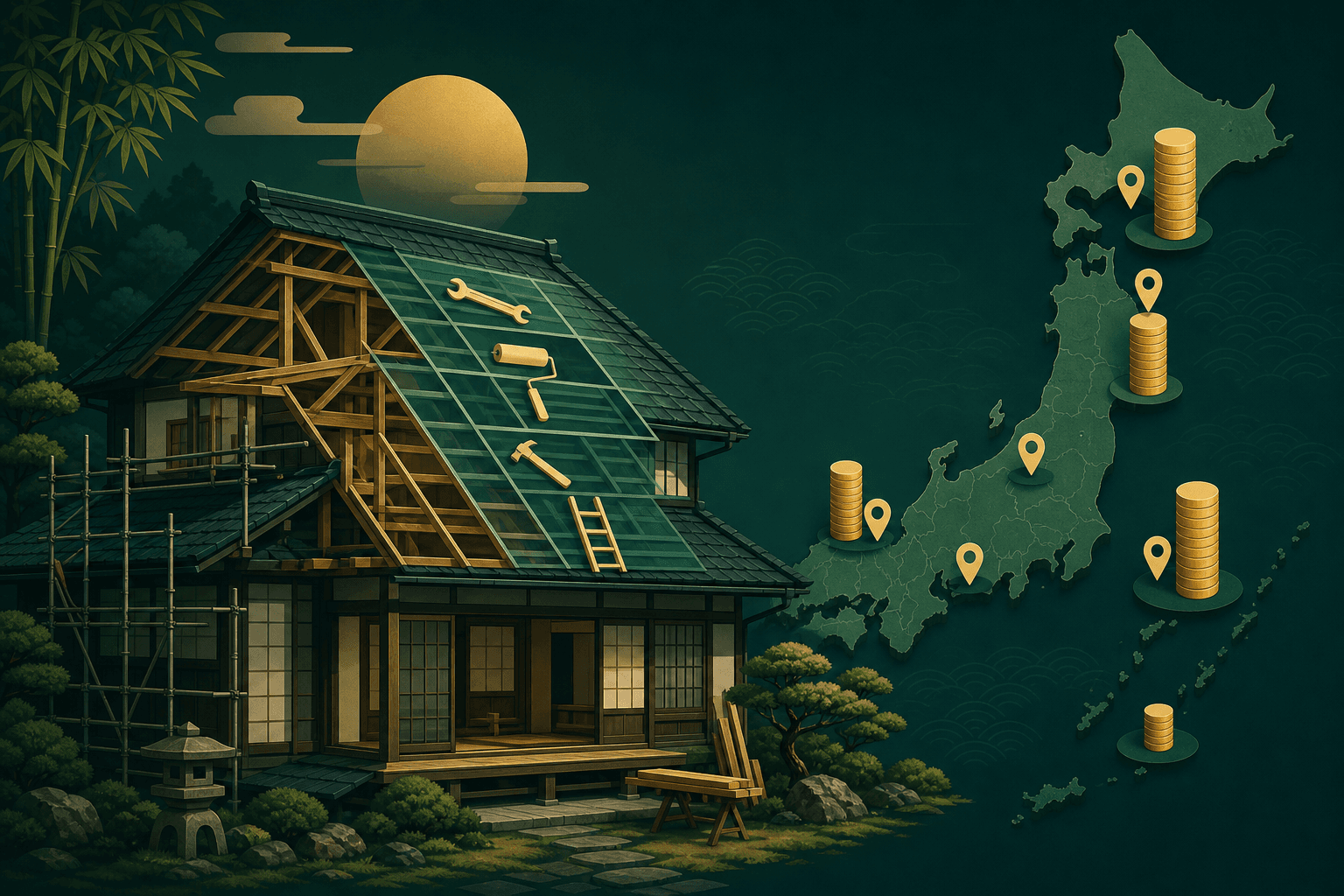
🔨 Key Takeaway: Akiya renovation budgets vary wildly by region — from ¥2M for a basic Tokushima livability rescue to ¥15M+ for a Hakuba ski-rental conversion with cold-climate spec. The single biggest mistake is using a national "average" number. This guide gives line-item breakdowns by trade and full project examples by region, including foreign-buyer-specific overhead and minpaku conversion adders.
The viral akiya headline ("$500 Japanese house!") rarely makes it past the line item that actually matters: the renovation cost. After analyzing pricing data from regional contractors, government subsidy disclosures, and published renovation case studies across Japan's main akiya regions, the honest range is ¥2M to ¥15M+ depending on what you buy, where you buy it, and what you intend to do with it.
This guide does what national-average articles refuse to do: separate renovation costs by region (climate and labor markets vary by 30–50%), by scope (cosmetic vs habitability vs structural vs commercial), and by buyer type (Japanese resident vs non-resident foreign). For broader context on whether akiya make sense at all, see Are Akiya Really Cheap? and The Hidden Costs of "¥0 Akiya".
Three Levels of Akiya Renovation
Before any line items, understand which level of renovation you actually need. The cost differential between levels is 5–10x.
Level 1: Cosmetic Refresh (¥0.5M–¥2M)
For akiya in genuinely good structural condition (rare): paint, flooring, light fixtures, deep cleaning. Almost no akiya truly qualifies — and properties marketed as "renovated" or "move-in ready" by akiya banks are usually Level 2.
Level 2: Habitability Renovation (¥2M–¥6M)
Restore the property to safely livable condition for an owner-occupier or long-term tenant. Includes water-supply restoration, electrical safety upgrade, kitchen and bathroom fixture replacement, exterior weatherproofing. The realistic floor for a useable akiya in most regions.
Level 3: Structural + Commercial Conversion (¥5M–¥15M+)
Earthquake retrofit, full systems replacement, insulation upgrade for climate, and — if intended for short-term rental — minpaku-specific fire safety code (smoke detectors, emergency lighting, rated finishes). For pre-1981 properties especially, retrofit costs alone can run ¥1.5–5M before any aesthetic work begins. See Pre-1981 Akiya Risk 2026 for the full structural framework.
The mistake most foreign buyers make is budgeting at Level 1 and discovering, after purchase, that the realistic scope is Level 3.
Line-Item Costs by Trade (National Baseline)
These ranges reflect typical 2026 pricing across Japan for a small-to-mid wooden detached house (~80–120㎡). Regional adjustments follow in the next section.
Roof (屋根) — ¥500,000–¥2,500,000
| Scope | Typical cost |
|---|---|
| Roof inspection + minor repair | ¥100,000–300,000 |
| Repaint of metal/cement roofing | ¥400,000–800,000 |
| Re-roof with new asphalt shingles | ¥800,000–1,500,000 |
| Re-roof with metal (snow regions) | ¥1,200,000–2,500,000 |
| Replace ceramic tile roof with lighter material | ¥1,500,000–3,000,000 |
Roof condition is the single best predictor of total renovation cost. Water intrusion through a failing roof creates structural damage, mold, and electrical issues that cascade through every other trade.
Exterior Walls (外壁) — ¥800,000–¥3,000,000
| Scope | Typical cost |
|---|---|
| Exterior repaint (siding) | ¥600,000–1,200,000 |
| Repaint + minor caulking repair | ¥800,000–1,500,000 |
| Re-side (galvalume metal) | ¥1,500,000–2,500,000 |
| Re-side with insulation upgrade | ¥2,000,000–3,500,000 |
In coastal regions (Wakayama, Okinawa), salt-air corrosion accelerates exterior wall degradation by approximately 2x compared to inland regions. Plan for repaint or re-siding even on relatively recent properties.
Kitchen, Bath, Toilet (水回り三点) — ¥1,500,000–¥4,000,000
The "water trio" (水回り) is where renovation budgets bloat fastest:
| Scope | Typical cost |
|---|---|
| Kitchen replacement (system kitchen, mid-grade) | ¥600,000–1,500,000 |
| Unit bath replacement (system bath) | ¥800,000–1,500,000 |
| Toilet replacement (Western style with bidet) | ¥150,000–400,000 |
| Wash basin replacement | ¥150,000–400,000 |
| Hot water heater replacement | ¥200,000–500,000 |
| All four ("水回り四点交換") | ¥1,800,000–4,000,000 |
For akiya targeting short-term rental, expect to invest in the upper half of this range — guests judge listings primarily by kitchen and bathroom quality.
Plumbing & Electrical (給排水・電気) — ¥500,000–¥2,500,000
| Scope | Typical cost |
|---|---|
| Electrical panel upgrade (50A → 60A or 200V) | ¥200,000–400,000 |
| Full electrical rewiring (~100㎡) | ¥800,000–1,500,000 |
| Water supply pipe replacement | ¥300,000–700,000 |
| Drain pipe replacement (older galvanized) | ¥400,000–1,000,000 |
| Septic system inspection / repair | ¥200,000–800,000 |
| Sewer connection (if not present) | ¥500,000–2,000,000 |
Older akiya frequently have galvanized water pipes, fuse-box electrical panels (not breaker), and aluminum or knob-and-tube wiring. Modern code compliance for an insured, financeable, rentable property typically requires full systems replacement.
Earthquake Retrofit (耐震補強) — ¥1,500,000–¥5,000,000
Specifically for pre-1981 wooden structures (most akiya):
| Scope | Typical cost |
|---|---|
| 耐震診断 (structural inspection) | ¥150,000–500,000 |
| Light retrofit (score 0.5 → 1.0) | ¥1,500,000–3,000,000 |
| Heavy retrofit (severe deficiencies) | ¥3,000,000–5,000,000+ |
See Pre-1981 Akiya Risk 2026 for the full retrofit framework. Government subsidies of ¥500,000–1,000,000 are available in many municipalities, though foreign-buyer eligibility varies.
Insulation (断熱) — ¥500,000–¥2,000,000
Older akiya are often built with minimal insulation. For year-round livability or short-term rental viability:
| Scope | Typical cost |
|---|---|
| Add ceiling/attic insulation | ¥150,000–400,000 |
| Add wall insulation (blown-in) | ¥400,000–1,000,000 |
| Replace single-pane glass with double | ¥600,000–1,500,000 |
| Full insulation + window upgrade | ¥1,500,000–3,000,000 |
In cold regions (Niseko, Hakuba, Hokkaido more broadly), insulation isn't optional — it's the largest contributor to year-round operating cost differential and tenant comfort. In tropical regions (Okinawa), insulation matters for AC efficiency and humidity control.
Interior (内装) — ¥500,000–¥3,000,000
| Scope | Typical cost |
|---|---|
| Wallpaper / paint (~100㎡ floor area) | ¥300,000–600,000 |
| Flooring replacement (wood/laminate) | ¥600,000–1,500,000 |
| Tatami → flooring conversion | ¥200,000–500,000 per room |
| Built-in storage modernization | ¥300,000–800,000 |
| Full interior refresh (paint + floor + storage) | ¥1,500,000–3,000,000 |
Pest, Mold, Moisture (防虫・防カビ・湿気対策) — ¥300,000–¥1,500,000
Almost universal in vacant houses, particularly in humid regions:
| Scope | Typical cost |
|---|---|
| Termite inspection + treatment | ¥150,000–400,000 |
| Termite damage structural repair | ¥500,000–2,000,000 |
| Mold remediation | ¥300,000–800,000 |
| Crawlspace moisture barrier installation | ¥200,000–500,000 |
For a focused look at termite risk specifically, a recurring foreign-buyer underestimate, watch for our forthcoming termite/seismic risk deep dive — the structural risk profile section in Pre-1981 Akiya Risk 2026 covers the intersection.
Demolition & Disposal (解体・撤去) — ¥500,000–¥2,000,000
For partial reno projects requiring removal of damaged walls, additions, or outbuildings:
| Scope | Typical cost |
|---|---|
| Interior demo only (small area) | ¥200,000–500,000 |
| Outbuilding demolition (storage shed, etc.) | ¥300,000–700,000 |
| Asbestos abatement (if applicable) | ¥500,000–2,000,000 |
| Industrial waste disposal | ¥100,000–500,000 |
Region-by-Region Real Project Examples
These examples reflect realistic full-project budgets for typical akiya renovation programs in each region. Adjust ±20% based on specific property condition and contractor selection.
Niseko / Kutchan Area — ¥4M–¥12M
The Niseko area combines pre-1981 housing stock prevalence with cold-climate spec requirements and a tight, foreign-language-friendly contractor market that prices accordingly.
Typical Niseko akiya renovation profile (¥1.5M property purchase, 90㎡ wooden detached, pre-1981, 30-min from Hirafu):
| Trade | Cost |
|---|---|
| Roof: re-roof with metal (snow load spec) | ¥1,800,000 |
| Earthquake retrofit (耐震補強) | ¥2,500,000 |
| Insulation: full upgrade for sub-zero winters | ¥2,000,000 |
| Water trio (kitchen, bath, toilet, hot water) | ¥2,200,000 |
| Plumbing freeze-protection upgrade | ¥600,000 |
| Electrical full rewire + panel upgrade | ¥1,000,000 |
| Interior refresh | ¥1,000,000 |
| Pest/mold treatment | ¥400,000 |
| Contingency (10%) | ¥1,150,000 |
| Total renovation | ¥12,650,000 |
For ski-rental conversion targeting peak winter ADR of ¥40,000+, add another ¥2–4M for furnishing, photography, listing setup, and minpaku-specific fire safety. See Niseko property prices, Hakuba pricing data, and Should you buy Niseko now or wait? for market context.
View real transaction prices, price trends, and investment analysis for Niseko / Kutchan based on MLIT government data.
Explore Niseko / Kutchan Data →Hakuba — ¥5M–¥15M
Hakuba's renovation cost profile is similar to Niseko but with even tighter contractor capacity during peak ski-prep months and higher demand for high-end finish quality from international buyers competing for the same rental market.
Typical Hakuba akiya renovation profile (¥3M property purchase, 110㎡ wooden detached, pre-1981, lodge-conversion target):
| Trade | Cost |
|---|---|
| Roof: full replacement with snow-shedding spec | ¥2,500,000 |
| Earthquake retrofit (heavy, score 0.4 → 1.0) | ¥3,500,000 |
| Insulation + window upgrade (R-30 equivalent) | ¥3,000,000 |
| Water trio + secondary bath addition | ¥3,500,000 |
| Plumbing + electrical full systems replacement | ¥2,000,000 |
| Interior: full refresh + tatami conversion | ¥2,000,000 |
| Pest/mold + crawlspace moisture control | ¥800,000 |
| Demolition: outbuilding removal | ¥600,000 |
| Contingency (10%) | ¥1,790,000 |
| Total renovation | ¥19,690,000 |
This budget assumes a Level 3 commercial conversion. A Level 2 owner-occupier renovation in the same property would land at ¥7–10M. For market context, see Hakuba property prices 2026.
View real transaction prices, price trends, and investment analysis for Hakuba based on MLIT government data.
Explore Hakuba Data →Tokushima Mountain Areas — ¥2M–¥6M
Tokushima Prefecture (~21% vacancy rate, the highest in Japan) sits at the opposite end of the renovation cost spectrum. Lower contractor labor costs, smaller property sizes, and weaker tourism-conversion incentives keep budgets tight.
Typical Tokushima akiya renovation profile (¥300,000 property purchase, 75㎡ wooden detached, pre-1981, lifestyle/migration target):
| Trade | Cost |
|---|---|
| Roof: re-roof with mid-grade asphalt | ¥900,000 |
| Earthquake retrofit (light, score 0.6 → 1.0) | ¥1,800,000 |
| Insulation: ceiling + critical walls only | ¥600,000 |
| Water trio (kitchen, bath, toilet) | ¥1,800,000 |
| Plumbing: pipe replacement + septic repair | ¥800,000 |
| Electrical: panel upgrade only | ¥300,000 |
| Interior refresh (paint + flooring) | ¥800,000 |
| Pest/termite treatment | ¥400,000 |
| Contingency (10%) | ¥740,000 |
| Total renovation | ¥8,140,000 |
For a basic livability rescue without retrofit (i.e., accepting the pre-1981 risk), this budget compresses to ¥3.5–5M. For overall context on declining-land regions where these projects sit, see akiya land price trends — Tokushima is in the "land falling, house worthless" tier, which structurally limits exit value regardless of renovation quality.
Wakayama Coast — ¥3M–¥8M
Coastal Wakayama renovation costs sit between Tokushima (depopulating mountain) and Okinawa (tourism-coastal) — typically owner-occupier-focused with salt-air-driven exterior premiums.
Typical Wakayama coastal akiya renovation profile (¥800,000 property purchase, 90㎡ wooden detached, pre-1981, ~10 min from coast):
| Trade | Cost |
|---|---|
| Roof: corrosion-resistant metal re-roof | ¥1,400,000 |
| Exterior re-siding (salt-air rated) | ¥2,200,000 |
| Earthquake retrofit + tsunami zone reinforcement | ¥2,500,000 |
| Water trio | ¥2,000,000 |
| Plumbing + electrical | ¥1,200,000 |
| Insulation (humidity control focus) | ¥800,000 |
| Interior refresh | ¥1,000,000 |
| Pest/mold (high humidity area) | ¥600,000 |
| Contingency (10%) | ¥1,170,000 |
| Total renovation | ¥12,870,000 |
For coastal properties, additionally verify tsunami inundation zone status. See Japan tsunami risk for coastal property foreign buyers 2026 — Wakayama Pacific coast is within the Nankai Trough projection zone, which compounds insurance cost and exit-value risk on top of renovation spend.
Okinawa (Naha / Coastal) — ¥3M–¥9M
Okinawa renovation costs are skewed by a different building stock (more concrete than wood vs the rest of Japan) and a unique pest/typhoon profile.
Typical Okinawa akiya renovation profile (¥2M property purchase, 80㎡ concrete-block detached, ~2km from beach):
| Trade | Cost |
|---|---|
| Roof: typhoon-rated reinforcement + waterproofing | ¥1,500,000 |
| Exterior: concrete spalling repair + repaint | ¥1,800,000 |
| Plumbing: replace galvanized with PEX | ¥800,000 |
| Electrical: typhoon-resilient circuit upgrades | ¥600,000 |
| Water trio | ¥2,000,000 |
| AC system installation/upgrade | ¥600,000 |
| Termite + moisture control | ¥800,000 |
| Interior refresh | ¥1,200,000 |
| Contingency (10%) | ¥933,000 |
| Total renovation | ¥10,233,000 |
Concrete-block construction (the dominant Okinawa building type) doesn't carry the same pre-1981 wooden-collapse risk profile. However, salt corrosion of internal rebar and concrete spalling create distinct deterioration patterns. For local context, see Naha real estate investment guide, Okinawa Onna, Chatan, Ishigaki, and Miyako.
View real transaction prices, price trends, and investment analysis for Naha / Okinawa based on MLIT government data.
Explore Naha / Okinawa Data →DIY vs Contractor: When the Math Flips
Foreign buyers often ask whether DIY renovation can substantially compress these budgets. The honest answer:
DIY can save 30–50% on cosmetic-level work: paint, basic flooring, fixture swaps, landscaping, deep cleaning. The savings are real, the risk is contained, and for owner-occupier akiya it can be the right call.
DIY rarely saves on Level 2/3 work:
- Plumbing and electrical require Japanese certifications (water supply construction certification 給水装置工事配管技能士, electrical work certification 電気工事士) for any work tied into municipal supply or main panel — DIY is illegal for these scopes
- Earthquake retrofit requires structural engineer sign-off — there is no DIY path
- Roofing in snow regions has fall-safety and load-spec requirements that justify contractor pricing
- Asbestos abatement is regulated work; DIY is illegal and dangerous
- Foreign buyers without language fluency face material-procurement and permitting overhead that erodes savings
Realistic DIY scope for foreign buyers:
- Demolition (interior non-structural only)
- Painting (interior + exterior, with appropriate coatings)
- Flooring (laminate, click-lock products)
- Cabinetry installation (post-installation by contractor of plumbing/electrical)
- Furnishing and styling (especially for minpaku conversion)
Estimate a realistic DIY contribution at 10–20% savings on a typical Level 2/3 budget — meaningful, but not transformative.
What Changes for Foreign Non-Resident Buyers
Foreign-buyer-specific renovation overhead is consistently underestimated:
Project Management Overhead — +10–25%
Coordinating contractors from overseas requires:
- A local representative or licensed real estate professional fluent in both languages
- Translation of contractor estimates, contracts, and structural reports
- Travel for at least 2–4 in-person site visits during the project
- Bank wire timing for Japanese payment schedules (大半の業者 pay in 30/60/30 splits or similar)
Budget +10–25% on top of contractor-quoted costs to account for this overhead. Owner-occupier renovations where the buyer travels frequently to Japan land at the lower end; pure remote management lands at the higher end.
Tax Representative & Reporting — ¥50,000–200,000
A non-resident owner generating any future rental income requires a 納税管理人 (tax representative) registered in Japan. Renovation costs are generally added to depreciable basis, which the tax representative tracks for future returns. See Japan property tax for foreign investors.
FEFTA Reporting Threshold — Time-Dependent
Total project costs (purchase + renovation + setup) above certain thresholds may trigger FEFTA reporting. See Japan 2026 foreign investor reporting law and FEFTA Form 22 filing guide.
Currency Risk on Multi-Year Project — ±5–10%
Budget JPY commitments paid out over 12–18 months expose you to FX volatility. On a ¥10M renovation, a 10% JPY appreciation against your home currency adds approximately $7,000 (USD baseline) to the effective cost. For transfer mechanics, see Sending Money to Japan for Property Purchase.
Minpaku Conversion Adders
If you intend to operate the renovated akiya as short-term rental, additional code-compliance costs apply on top of standard renovation:
| Item | Typical cost |
|---|---|
| Smoke detectors (every sleeping room + escape paths) | ¥80,000–200,000 |
| Emergency lighting (誘導灯) | ¥150,000–400,000 |
| Fire extinguisher provisioning | ¥30,000–80,000 |
| Fire-rated finish upgrades (if required) | ¥300,000–1,500,000 |
| Egress path compliance modifications | ¥200,000–800,000 |
| Furnishing for rental (¥1.5–3M typical) | ¥1,500,000–3,000,000 |
| Photography + listing setup | ¥80,000–200,000 |
| Minpaku conversion add-on total | ¥2,300,000–6,200,000 |
For the full minpaku regulatory framework specifically applied to akiya, see Akiya for Minpaku 2026: Which Vacant Homes Qualify. For city-by-city realistic minpaku yields after these costs, see Minpaku ROI 2026: Realistic Yields by Japanese City.
Government Subsidies — What Foreign Buyers Can Realistically Access
Subsidy availability for akiya renovation varies enormously by municipality. Common subsidy categories:
Akiya Bank Renovation Subsidies (空き家バンク改修補助金)
- Typical amount: ¥300,000–1,000,000 toward renovation costs
- Eligibility: usually requires registration as primary residence (not investment), which often excludes non-resident foreign buyers
- Application: must apply before starting work; retroactive applications rejected
Earthquake Retrofit Subsidies (耐震改修補助金)
- Typical amount: ¥500,000–1,000,000 toward retrofit cost
- Eligibility: pre-1981 wooden detached houses; some municipalities limit to owner-occupied or to Japanese residents
- Application timing: requires 耐震診断 first, then application before retrofit work
Migration / Settlement Incentives (移住・定住補助金)
- Typical amount: ¥200,000–2,000,000 in lump-sum and ongoing tax breaks
- Eligibility: requires actual migration with住民票 registration and continuous residency obligations (typically 3–10 years)
- Foreign buyer applicability: limited; requires resident status and intent to stay long-term
Energy Efficiency Subsidies (省エネ改修補助金)
- National program: 子育てエコホーム支援事業 and similar national programs; available regardless of nationality if conditions are met
- Typical amount: ¥100,000–600,000 for qualifying upgrades (insulation, windows, hot water systems)
- Foreign buyer applicability: generally accessible; one of the more reliable subsidy categories
The honest expectation for foreign non-resident buyers: assume zero subsidy in your underwriting, treat any subsidy received as upside. Subsidy programs change yearly, application processes are entirely in Japanese, and many programs explicitly exclude non-resident applicants.
How to Build Your Akiya Renovation Budget
The honest sequence for accurate budgeting:
- Contractor site visit — get a written estimate from at least two contractors after physical inspection. Remote estimates from photos run 30–50% optimistic.
- 耐震診断 for any pre-2000 wooden property — see Pre-1981 Akiya Risk 2026 for the framework.
- Building inspector report (建物状況調査) — separate from earthquake inspection, covers overall structural and systems condition. ¥80,000–200,000.
- Contingency at 15–20% — not 10%. Akiya renovation surprises (unforeseen termite damage, hidden structural issues, asbestos discoveries) consistently push final costs above the original estimate.
- Foreign-buyer overhead at +15% on contractor totals.
- Multi-bid for any line item over ¥1M — single-source contractor pricing in regional markets carries a 10–25% premium.
- Cash flow planning — most contractors require 30/60/30 or similar payment schedules, with foreign-currency wire mechanics adding 1–2 weeks per transfer.
- Pre-approve subsidies before starting work — retroactive applications are universally rejected.
A realistic foreign-buyer akiya project budget starts at the contractor's estimate, multiplied by 1.20–1.30 to account for contingency and foreign-buyer overhead. If the multiplied number breaks your investment thesis, the deal does not work — full stop.
Pulling It All Together — Three Realistic Scenarios
Scenario A: Tokushima Lifestyle Migration (¥4–6M total)
- Property: ¥300,000 for 75㎡ wooden detached, pre-1981
- Renovation: Level 2 habitability, light retrofit (~¥4M)
- Subsidies accessed: minimal for non-resident; ~¥0–200,000 if migration-eligible
- Foreign-buyer overhead: +¥600,000
- All-in: ¥4.9–5.5M
Scenario B: Niseko Ski Rental Conversion (¥18–22M total)
- Property: ¥1.5M for 90㎡ wooden detached, pre-1981, 30-min from Hirafu
- Renovation: Level 3 with full retrofit (~¥12M)
- Minpaku conversion: ¥4–5M
- Foreign-buyer overhead: +¥2.5M
- All-in: ¥20–22M
Scenario C: Okinawa Coastal Second Home (¥10–14M total)
- Property: ¥2M for 80㎡ concrete-block detached, ~2km beach
- Renovation: Level 2 + typhoon hardening (~¥8M)
- Foreign-buyer overhead: +¥1.5M
- All-in: ¥11.5–13.5M
The headline price in all three scenarios was a small fraction of total project cost. Renovation, not purchase, is what determines whether the akiya math actually works.
For the bigger investment-decision context: the akiya vs Tokyo condo head-to-head shows that the all-in totals above (¥5–22M) overlap directly with central Tokyo, Osaka, and Fukuoka condo prices that come pre-renovated, in liquid markets, and on appreciating land. Always run that comparison before committing.
Frequently Asked Questions
What is the typical renovation cost for a Japanese akiya in 2026?
Typical full-renovation budgets range from ¥2M (basic livability rescue in low-cost regions) to ¥15M+ (full structural retrofit + commercial conversion in tourism regions). National-average figures are misleading because climate, labor markets, and project scope vary by 5–10x across regions. Use region-specific examples and add 15–20% contingency.
How much does it cost to renovate a kitchen and bathroom in a Japanese house?
The "water trio" of kitchen, bath, and toilet typically runs ¥1.5M–¥4M for replacement. Adding a hot water heater pushes the total to ¥1.8M–¥4.5M. For akiya targeting short-term rental, expect to invest in the upper half of this range as guests judge listings primarily by kitchen and bathroom quality.
Can foreign non-residents access akiya renovation subsidies?
Most municipal akiya renovation subsidies require primary-residence registration (住民票), which excludes most non-resident foreign buyers. National energy-efficiency subsidies (子育てエコホーム支援事業 and similar) are more accessible regardless of residency. Plan your underwriting assuming zero subsidy; treat any received as upside.
Is DIY renovation realistic for foreign buyers?
DIY can save 30–50% on cosmetic work (paint, flooring, fixture swaps) but is illegal for plumbing and electrical work tied to municipal supply, structural retrofit, and asbestos abatement — all of which require Japanese certifications. For foreign buyers without language fluency, realistic DIY savings on a Level 2/3 project are 10–20% net of permitting and procurement overhead.
How much does earthquake retrofit cost for an akiya?
Earthquake retrofit (耐震補強) for a typical pre-1981 wooden akiya runs ¥1.5M–¥5M depending on starting structural condition. Add ¥150,000–500,000 for the initial 耐震診断 inspection. Government subsidies of ¥500,000–1,000,000 are available in many municipalities for owner-occupied properties; foreign-buyer eligibility varies. See Pre-1981 Akiya Risk 2026 for the full framework.
What's the cheapest realistic akiya renovation budget?
In a low-cost region (Tokushima, Wakayama, Shimane) with a property that doesn't require structural retrofit, a basic Level 2 livability rescue starts around ¥2.5M–¥3.5M. Below that range, you are typically looking at properties with hidden defects, deferred maintenance, or pre-1981 structural deficiencies that will surface after purchase.
Should I budget more for tourism regions like Niseko or Hakuba?
Yes. Cold-climate spec (insulation, freeze-resistant plumbing, snow-load roofing), tighter contractor markets, and higher finish quality demanded by international rental guests push tourism-region renovation budgets 50–100% higher than equivalent work in declining rural prefectures. Niseko/Hakuba renovation projects typically land at ¥10–20M+ all-in for serious commercial conversion.
Related Articles
- Pre-1981 Akiya Risk 2026: Why 60%+ Fail Modern Earthquake Code →
- Japan's 9 Million Vacant Houses 2026: Government Data →
- Are Akiya Really Cheap? Government Data Shows the True Cost →
- The Hidden Costs of "¥0 Akiya" 2026 →
- Akiya for Minpaku 2026: Which Vacant Homes Qualify →
- Best Akiya Areas in Japan 2026: Data-Driven Ranking →
- Akiya Land Price Trends Japan 2026 →
- Akiya vs Tokyo Condo: Which Investment Makes Money →
- Akiya Actual Prices: MLIT Transaction Data vs Suumo →
- Japan Earthquake & Tsunami Risk for Property Investors →
- Minpaku ROI 2026: Realistic Yields by Japanese City →
- Sending Money to Japan for Property Purchase →
- Japan Property Tax Guide for Foreign Investors →
Data Sources & Citations
- Construction cost benchmarks: 国土交通省 建築費調査, regional contractor estimates (2026 published rates)
- Subsidy programs: 国土交通省 住宅関連補助金, municipal akiya bank disclosures
- Earthquake retrofit pricing: Japan Building Disaster Prevention Association (日本建築防災協会)
- Energy efficiency programs: 子育てエコホーム支援事業 (national), regional energy-saving subsidy programs
- Vacant housing statistics: 総務省 住宅・土地統計調査 2023
Disclaimer
This article provides estimated renovation cost ranges for educational purposes. Actual costs vary substantially by specific property condition, regional contractor markets, material price fluctuations, and project scope. Always obtain at least two written contractor estimates after physical site inspection before committing to purchase. Subsidy programs change yearly and have specific eligibility requirements. Consult qualified Japanese construction professionals, structural engineers, and tax representatives for property-specific advice.