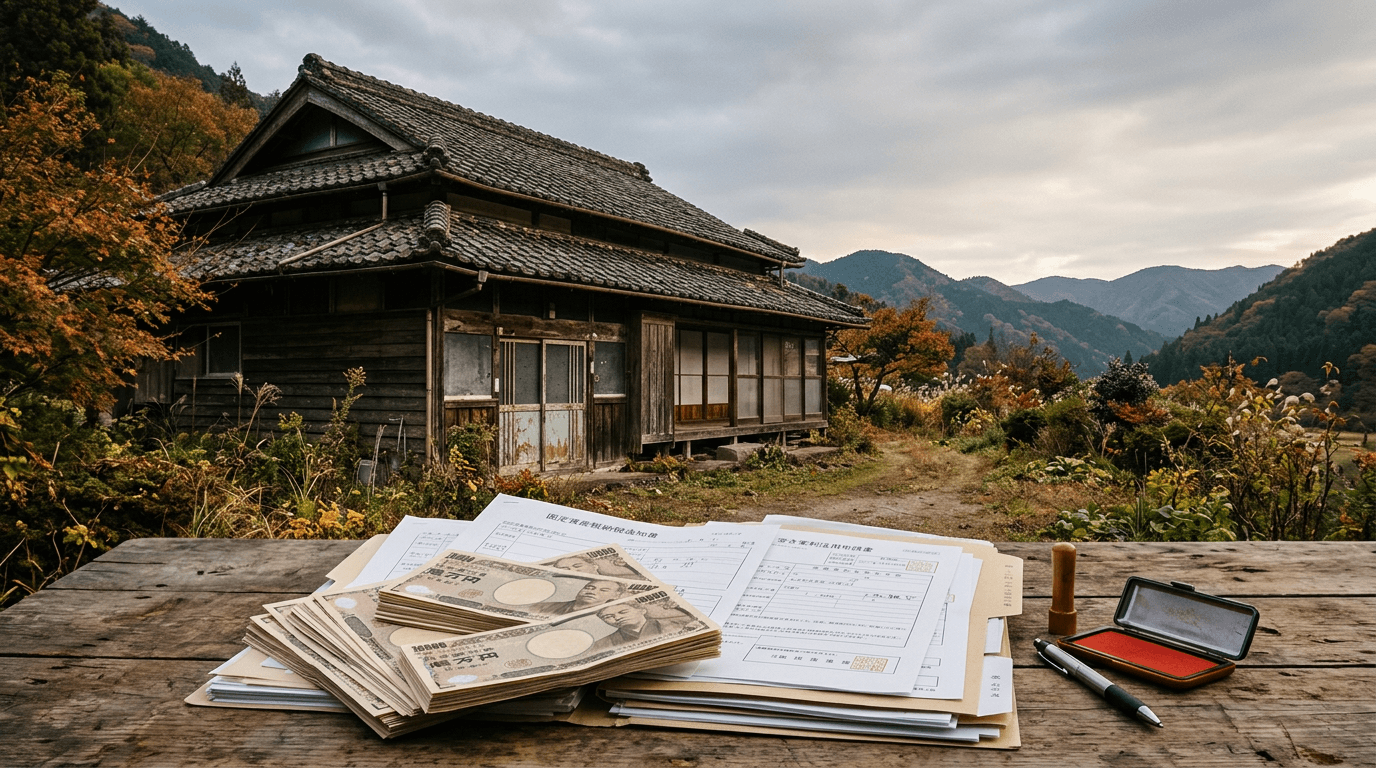
💰 Key Takeaway: A "free" akiya rarely stays free. For foreign non-residents, total acquisition costs typically land between ¥3M–¥5M even when the property itself is ¥0–¥500K. Below is every hidden cost, broken down by category, with three realistic scenarios.
The viral version of the story is irresistible: a ¥0 Japanese house, a rustic rural retreat, a new life bought for less than a used car. CNN, Bloomberg, and half of YouTube have run some version of it. What those stories almost never include is the line item that turns a free house into a ¥5M project — and for foreign non-residents, several extra line items that don't apply to Japanese buyers at all.
This article is written for one specific reader: the person who saw a "$500 akiya" video, felt the spark, and is now trying to decide whether to actually pursue it. If that's you, the numbers below are the ones nobody sends in the DMs. They're not meant to scare you off. They're meant to help you decide honestly — because akiya do make sense for some buyers, and they are a quiet disaster for others.
The "¥0 Akiya" Narrative and Where It Breaks Down
Japan has roughly 9 million vacant houses (空き家 / akiya), and thousands of them list for ¥0 or symbolic prices on municipal akiya banks (空き家バンク). The media framing is technically accurate: those listings are real, those prices are real, and foreigners can buy them. Japan has zero restrictions on foreign property ownership — no approval process, no nationality filter, no residency requirement.
What the narrative leaves out:
- Japanese buyers overwhelmingly pass on these properties. In a country where home ownership is culturally valued and domestic prices are low by global standards, the fact that local buyers aren't snapping up ¥0 houses should be your first data point. They're reading the same numbers we're about to show you.
- "¥0" is the seller's exit price, not the buyer's entry cost. The seller wants out of the property tax obligation and the legal liability. You're inheriting both.
- The social media hero images are post-renovation. The ¥5M–¥10M renovation is in the "before" versus "after" frame — it just isn't in the price tag.
For the bigger-picture data on which akiya regions have rising versus declining land values, see our akiya land price trends analysis and the best akiya areas ranking. For what akiya actually sell for versus what you see on Suumo and Athome — the 15–40% asking-vs-sold gap by prefecture — see our MLIT actual transaction prices analysis. This article focuses on the costs that apply regardless of region.
The Six Hidden Cost Categories
Every akiya purchase, even one where the headline price is ¥0, runs through the same six cost buckets. Here is the summary — each category is unpacked below.
| # | Cost Category | Typical Range (¥) | Likelihood |
|---|---|---|---|
| 1 | Unpaid property tax arrears (滞納固定資産税) | ¥200K – ¥2M | Common for long-vacant properties |
| 2 | Renovation to livable standard | ¥1.5M – ¥5M | Nearly universal |
| 3 | Registration & legal fees (司法書士費用) | ¥150K – ¥400K | Always required |
| 4 | Demolition (if unsalvageable) | ¥1M – ¥3M | Only for worst-condition akiya |
| 5 | Utility reconnection fees | ¥200K – ¥500K | Common when vacant >2 years |
| 6 | Ongoing property tax on unused property | ¥100K – ¥500K/year | Permanent |
1. Unpaid Property Tax Arrears (滞納固定資産税)
When a property sits vacant for years — especially after an owner dies and heirs avoid the inheritance — property tax obligations can stack up. In Japan, these arrears attach to the property, not just the previous owner. Depending on how the sale is structured, a foreign buyer can inadvertently step into unpaid back taxes.
Typical range: ¥200,000 – ¥2,000,000 for properties vacant 10+ years, especially those acquired through inheritance and then abandoned.
How to verify before signing: Request a 固定資産税評価証明書 (property tax assessment certificate) and a statement of any outstanding tax balance from the municipal government. Your 司法書士 (judicial scrivener) can pull this. Non-negotiable — do not sign anything before seeing a clean tax certificate.
2. Renovation to Livable Standard
This is the single largest line item for most akiya, and the one buyers most consistently underestimate. "Livable" doesn't mean Instagram-ready. It means: the roof doesn't leak, the plumbing carries clean water, the electrical system won't burn the house down, and the structure won't collapse in a moderate earthquake.
Typical range: ¥1.5M – ¥5M for basic rehab on a small rural house in usable-but-neglected condition. Full restoration (insulation, kitchen, bathrooms, structural reinforcement) routinely runs ¥5M – ¥15M. For a component-by-component breakdown (roof, plumbing, wiring, termite, earthquake retrofitting), see our akiya real cost guide.
Cost escalation factors foreign buyers miss:
- Rural contractor scarcity. In depopulated areas, there may be only one or two active contractors within a reasonable distance. Less competition means higher quotes.
- Distance surcharges. If materials and labor have to be brought in from a larger city, that travel time is billed.
- Language and remote coordination. If you're not on-site, you'll either need a bilingual project manager (~¥30K–¥80K per visit) or you'll eat the cost of misunderstandings.
- Permit delays in old structures. Pre-1981 buildings may need structural engineering review before major work. Budget for the engineer's fee (~¥100K–¥300K) and for the time cost of delay.
3. Registration & Legal Fees (司法書士費用)
Every property transfer in Japan requires registration at the Legal Affairs Bureau (法務局), which is handled by a 司法書士 (shihōshoshi, judicial scrivener). This is not optional.
| Item | Typical Range (¥) |
|---|---|
| Shihōshoshi professional fees | ¥80,000 – ¥200,000 |
| Registration tax (登録免許税) — ownership transfer | ~2% of assessed value (reduced for primary residence) |
| Registration tax — building registration | ~0.4% of assessed value |
| Certificate and document fees | ¥10,000 – ¥30,000 |
| Typical total | ¥150,000 – ¥400,000 |
Non-resident-specific complications: you'll likely need a 在留証明 substitute (a sworn affidavit or an apostilled certificate of residence from your home country), which adds translation and notarization costs (¥20K–¥80K). If you can't be physically present for signing, you'll also pay for a power of attorney (委任状) prepared and notarized abroad.
For the full breakdown of every one-time transaction fee a foreign buyer pays in Japan — including acquisition tax and agent commission, which apply on top of the items above — see our Japan property buying costs guide.
4. Demolition Costs (If Unsalvageable)
Some akiya are beyond rehabilitation. The roof has failed, the frame is rotten, the foundation has shifted, or the house is so small and poorly located that renovation cost exceeds rebuild cost. In these cases, the "asset" is actually the cleared land, and demolition is a mandatory expense.
Typical range: ¥1,000,000 – ¥3,000,000 for a standard 120㎡ single-family wooden house, based on Japan's national demolition contractor association data. The range is wide because:
- Asbestos surcharges: Houses built before ~1990 often contain asbestos in roofing, siding, or insulation. Licensed asbestos abatement can add ¥500K–¥1.5M.
- Access restrictions: If the property is on a narrow road or hillside where heavy equipment can't easily reach, manual demolition dramatically raises costs.
- Debris disposal: Volumes are charged by weight and category. Mixed waste costs more than segregated waste.
After demolition, the 固定資産税 (fixed asset tax) on the cleared land typically rises by up to 6x because the small-lot residential tax reduction (住宅用地特例) no longer applies. This is a critical number — see category 6.
5. Utility Reconnection Fees
A house vacant for 5+ years has typically had its water, gas, and electricity accounts closed, and its sewage or septic system may have deteriorated. Reactivation is rarely plug-and-play.
| Utility | Typical Reconnection Cost (¥) | Common Complications |
|---|---|---|
| Water (municipal) | ¥30,000 – ¥150,000 | Corroded pipes, failed meter |
| Gas (propane or city) | ¥20,000 – ¥80,000 | Tank replacement, line inspection |
| Electricity | ¥10,000 – ¥50,000 | Rewiring if aluminum wiring or rodent damage |
| Septic tank / well | ¥100,000 – ¥500,000 | Common in rural areas; some require full replacement |
| Typical total | ¥200,000 – ¥500,000 | Higher in mountain and island regions |
Rural properties often have private well water and septic systems (浄化槽) rather than municipal connections. A failed septic tank is not a small repair — full replacement can approach ¥1M.
6. Ongoing Property Tax on Unused Property
Even if you never live in the akiya, you owe annual 固定資産税 (fixed asset tax) and 都市計画税 (city planning tax) every year you own it. On a small rural property this often runs ¥30,000–¥100,000/year — manageable, but permanent. Two complications make this bigger than it looks.
Complication 1: The 特定空家 designation (up to 6x tax increase). Under the Special Measures Act on Vacant Houses (空家等対策の推進に関する特別措置法), municipal governments can designate a neglected akiya as a 特定空家 (specified vacant house). When this happens, the small-lot residential tax reduction is revoked and the property's effective fixed asset tax can rise up to six times the prior rate. Common triggers: visible structural danger, pest infestation, overgrown vegetation, or complaints from neighbors. A ¥50,000/year tax bill becomes a ¥300,000/year tax bill — for a house you can't live in.
Complication 2: Non-resident holding costs stack up. Annual property tax is just one line. Property management fees, periodic travel for inspections, insurance, and (for long-vacant rural structures) repair reserves add another ¥100K–¥300K/year. Our Japan property running costs guide breaks down the full annual cost picture for non-resident owners.
Typical annual holding cost range: ¥100,000 – ¥500,000/year, assuming no 特定空家 designation. With designation, the low end of the range becomes the new starting point.
Three Concrete Scenarios With Real Numbers
These scenarios are illustrative composites based on real akiya-bank listings and contractor quotes from 2025–2026. Property prices, tax figures, and renovation scopes are specific and realistic. Outcomes differ by region and property condition.
Scenario A: The ¥0 "Free" Akiya That Cost ¥5.2M Total
A 45-year-old wooden house in a depopulated Shikoku town, listed at ¥0 on the municipal akiya bank. Foreign non-resident buyer, purchased remotely, intending to use as a vacation home.
| Line Item | Cost (¥) |
|---|---|
| Purchase price | 0 |
| Unpaid property tax arrears | 380,000 |
| Registration & legal fees (shihōshoshi + registration tax) | 180,000 |
| Acquisition tax (不動産取得税) | 40,000 |
| Initial utility reconnection (incl. failed septic replacement) | 720,000 |
| Roof replacement | 1,600,000 |
| Plumbing full replacement | 900,000 |
| Electrical rewiring + panel upgrade | 450,000 |
| Termite treatment and structural patching | 380,000 |
| Interior minimum livable fit-out (one bedroom, one bathroom, kitchen) | 350,000 |
| Non-resident legal / POA / translation costs | 120,000 |
| Travel (2 trips for inspection + closing) | 280,000 |
| Total Year 0 cost | ¥5,400,000 |
What the headline said: free. What the cash-out-of-pocket actually was: ¥5.4M before a single night was spent in the house.
Scenario B: The ¥500K "Bargain" That Ended at ¥3.1M
A 35-year-old house in rural Nagano, well-maintained exterior but dated interior. Foreign non-resident buyer, purchased after a site visit, intending to use as a seasonal rental (minpaku).
| Line Item | Cost (¥) |
|---|---|
| Purchase price | 500,000 |
| No tax arrears (owner was paying taxes until sale) | 0 |
| Registration & legal fees | 210,000 |
| Acquisition tax | 80,000 |
| Agent commission + stamp duty | 90,000 |
| Utility reconnection | 180,000 |
| Minor roof repair and gutter replacement | 450,000 |
| Insulation upgrade (winter livability) | 700,000 |
| Kitchen and bathroom refresh | 520,000 |
| Minpaku licensing upgrades (fire alarms, signage, egress) | 180,000 |
| Non-resident legal / representation | 100,000 |
| Travel + on-site coordination | 150,000 |
| Total Year 0 cost | ¥3,160,000 |
This is the realistic "successful" akiya outcome. The buyer paid 6x the headline price but ended with an actually rentable property in a region where tourism demand exists. Before committing to any minpaku project, verify the local rules — our Japan minpaku rules guide covers which municipalities restrict operation days and which require additional permits.
Scenario C: The Honest ¥2M Akiya That Became ¥2.8M (fair outcome)
A 25-year-old house in a Kansai suburban town, listed at ¥2M, in genuinely move-in-ready condition. Foreign resident buyer (lives in Japan), buying as a primary or second home.
| Line Item | Cost (¥) |
|---|---|
| Purchase price | 2,000,000 |
| Registration & legal fees | 220,000 |
| Acquisition tax (reduced owner-occupier rate) | 90,000 |
| Agent commission + stamp duty | 180,000 |
| Utility reconnection (short vacancy) | 80,000 |
| Cosmetic repairs and minor plumbing | 220,000 |
| Furnishing and move-in basics | 30,000 |
| Total Year 0 cost | ¥2,820,000 |
This is what a fair akiya transaction looks like. The price was set by someone who understood the market; the property was priced at what it was actually worth; the surprises were small. Many thousands of akiya trade at this kind of price — they simply don't make for viral "free house" content.
The pattern across A, B, and C: the lower the headline price, the higher the multiplier from headline to total cost. A ¥0 akiya is often more expensive, in total, than a ¥2M akiya.
Non-Resident Specific Costs Most Buyers Miss
Everything above applies to any akiya buyer. The items below apply specifically to foreign non-residents — people who don't live in Japan at the time of purchase. These are the costs that are easiest to overlook because local real estate agents often don't bring them up until you ask.
| Cost Item | Typical Range (¥/year or one-time) | Notes |
|---|---|---|
| Tax representative (納税管理人) annual fee | ¥50,000 – ¥200,000/year | Required by law for non-residents to receive tax notices |
| International wire transfer fees | ¥3,000 – ¥15,000/wire | Per transaction; multiple wires often needed |
| FX spread on JPY conversion | 0.5% – 3% of transfer amount | Often larger than the wire fee itself |
| FEFTA (外為法) reporting compliance | ¥0 – ¥50,000 | Free if self-filed; accountant fees if delegated |
| Travel costs for closing and inspections | ¥200,000 – ¥500,000 | Typically 2–3 trips across a purchase cycle |
| Local representation / power of attorney (if absent) | ¥50,000 – ¥200,000 | Apostille, translation, notarization |
| Property management for vacant periods | ¥50,000 – ¥200,000/year | Essential for non-residents |
Tax representative (納税管理人). Japan's tax authorities require non-residents with property tax obligations to appoint a local tax representative to receive notices and handle filings. This is a legal requirement, not a nice-to-have. Fees vary widely — a Japanese friend may do it for free, but a professional (accountant or property manager) typically charges ¥50K–¥200K/year.
International transfers and FX. Wiring funds for the purchase itself, plus ongoing tax and management payments, accumulates. For a detailed walkthrough of compliant transfer methods, see our sending money to Japan guide. Most buyers lose more to FX spreads than to wire fees — a 2% spread on a ¥5M transfer is ¥100K.
FEFTA reporting. Foreign buyers of Japanese real estate may be subject to reporting under the Foreign Exchange and Foreign Trade Act (外為法). The rules changed in 2024–2025 and continue to evolve. For the current status and filing mechanics, see our FEFTA 2026 reporting guide and the step-by-step Form 22 filing walkthrough. Non-filing carries penalties; getting this right upfront is cheaper than fixing it later.
Financing assumption. Almost every akiya purchase by a non-resident is a cash transaction. Japanese banks rarely finance rural akiya for anyone, and essentially never for non-residents. For what does and doesn't work with foreign borrowers, see our Japan mortgage options for foreign buyers guide.
When Akiya Actually Makes Sense — A Decision Framework
The honest answer is: sometimes. Here is a clear decision framework grounded in the numbers above.
Use case 1: Vacation / personal use. Akiya can work beautifully. The investment math is irrelevant because you're consuming the property as a lifestyle asset. The key question is whether the total cost (acquisition + renovation + 5 years of holding cost) delivers enough enjoyment value to justify the spend. If yes, buy. If the math only works as an "investment," this is not the use case for you.
Use case 2: Minpaku / short-term rental investment. Can work, but the qualifiers are strict. The property must be in an area with genuine tourism demand (not hoped-for demand), the municipality must allow year-round operation (many cap at 180 days), and the acquisition-plus-renovation budget must still leave the project at a reasonable entry cost relative to nightly rates. See our akiya for minpaku qualification guide for which vacant-home profiles actually clear the four legal barriers, the minpaku rules guide, and the akiya vs Tokyo condo comparison for how the yields stack up.
Use case 3: Long-term residential rental. Usually poor math. The rural areas where cheap akiya exist tend to have weak and shrinking rental demand. Monthly rents of ¥30K–¥60K rarely cover the combined ownership and management cost, let alone the renovation amortization. If long-term rental income is your goal, an urban condo almost always outperforms — see our rental yields by area analysis.
Use case 4: Land value play. Only works in specific geographies. In most akiya-heavy prefectures, land value is flat or falling. The exceptions — Niseko, Hakuba, Karuizawa, parts of Okinawa, and a handful of semiconductor-adjacent towns — are where land is rising fast enough to justify buying the structure cheaply just to hold the dirt under it. See the best akiya areas ranking for where the data supports this strategy.
If none of these four use cases fit your situation, that's not a failure — that's the decision framework working. The right call might be to skip akiya entirely and focus on a different segment of Japan's property market.
How to Protect Yourself Before Signing
Eight items to run through before you commit. This is not exhaustive — our full due diligence checklist covers property inspection in more depth — but these are the akiya-specific items most often missed by foreign buyers.
- Get a clean property tax certificate (固定資産税評価証明書) showing no outstanding arrears. If there are arrears, confirm in writing who pays them off at closing.
- Pull the property registry (登記簿謄本) and verify there are no liens, secondary mortgages, or inheritance disputes unresolved among heirs. Akiya inherited from a deceased owner sometimes have multiple undocumented co-heirs.
- Commission a professional building inspection (建物状況調査) — ¥50,000–¥100,000, and the best money you spend in the whole process. This reveals structural, roof, plumbing, and termite issues that turn into million-yen surprises after you own the property.
- Get at least two independent renovation estimates from local contractors, itemized by trade. Headline "renovation budgets" are usually too low; itemized estimates force reality.
- Check the 特定空家 status risk. Has the municipality flagged the property? How long since it was last occupied? Neighbor complaints on file? Ask the municipal office directly.
- Verify utility and sewage infrastructure in writing. Municipal water vs. well. Sewer line vs. septic tank. Who owns the access road — is it public, private, or a shared road with maintenance fees?
- Negotiate contingencies into the contract. Inspection contingency, renovation-estimate contingency, and a clean-title warranty are all reasonable to ask for. Walking away before closing is far cheaper than walking away after.
- Confirm earthquake insurance availability. Pre-1981 wooden structures are sometimes uninsurable for earthquake damage, or insurable only at punitive premiums. Our property insurance guide walks through what is and isn't coverable. No insurance = full earthquake exposure on top of renovation spend.
Conclusion: Honest Math Leads to the Right Decision
Akiya aren't a scam. They aren't even a bad deal in every case. What they are is a market where the headline price systematically understates the true cost, and where foreign non-residents carry several layers of friction that domestic buyers don't. The buyers who end up happy are the ones who priced in all six hidden cost categories — plus the non-resident-specific items — before committing.
If, having read all of the above, your budget still holds, your use case still makes sense, and your target property still checks the eight due-diligence items, then an akiya purchase may genuinely fit your situation. If any of those feel shaky, that's the article doing its job. Walking away from a bad akiya deal is worth more than any ¥0 listing.
JRE publishes actual MLIT government transaction data for 20+ areas in Japan — the real prices people have paid, not the listing prices. Before you commit to a specific region, check whether the underlying market data supports your decision.
Explore Locations — MLIT transaction data for 20+ areas →
Frequently Asked Questions
Is buying a ¥0 akiya really free?
No. The ¥0 figure is the transfer price of the structure, not the total cost of acquisition or ownership. Expected additional costs include registration and legal fees (¥150K–¥400K), renovation to livable standard (typically ¥1.5M–¥5M), utility reconnection (¥200K–¥500K), and ongoing annual property tax (¥100K–¥500K/year). For a foreign non-resident buyer, total Year 0 cost on a headline-free akiya routinely lands between ¥3M and ¥5M.
What are the total costs of buying an akiya as a foreign non-resident?
For a realistic rural akiya purchase, budget ¥3M–¥5M for a minimal-effort case and ¥5M–¥15M for a full renovation case. That figure includes six cost categories — purchase price, back-tax arrears, registration and legal fees, renovation, utility reconnection, and demolition (if required) — plus non-resident-specific items such as tax representative fees, international transfer costs, FEFTA compliance, travel, and local representation. Ongoing annual holding cost typically runs ¥100K–¥500K/year.
What is a 特定空家 designation and how does it affect costs?
A 特定空家 (specified vacant house) is a municipal designation applied under the Special Measures Act on Vacant Houses. Triggers include structural danger, pest infestation, overgrown vegetation, or persistent neighbor complaints. Once designated, the small-lot residential tax reduction (住宅用地特例) is revoked, and the property's effective fixed asset tax can rise up to six times the prior rate. A designated property that previously owed ¥50K/year in tax may owe ¥300K/year — with no change in your ability to use it.
Do foreign non-residents need a tax representative in Japan?
Yes. Japan's tax authorities require non-residents with Japanese tax obligations to appoint a 納税管理人 (tax representative) — a local party who receives tax notices and handles filings on the owner's behalf. This requirement applies to any non-resident property owner. Fees range from free (if a trusted friend agrees to act) to ¥50K–¥200K/year for a professional. Failure to appoint one can result in missed tax notices and escalating penalties.
Can I back out of an akiya purchase after inspection?
Only if you negotiated the right contingencies into the contract before signing. Japanese real estate contracts do not have an automatic inspection contingency; anything you need must be written in. Standard protections to request include an inspection contingency (allowing withdrawal if a professional inspection finds material defects), a renovation-estimate contingency (allowing withdrawal if repair quotes exceed a threshold), and a clean-title warranty. Once a contract is signed without contingencies and earnest money (手付金) is paid, backing out typically forfeits the deposit.
Related Reading
- Pre-1981 Akiya Risk 2026: Why 60%+ Fail Modern Earthquake Code — The structural-code risk hiding inside most "¥0 akiya" listings
- Akiya Renovation Costs 2026: Real Examples by Region — Region-specific line-item budgets for the renovation costs in this article
- Japan's 9 Million Vacant Houses 2026: Government Data — Why the "¥0 akiya" pipeline keeps growing and what 2030/2040 looks like
- Are Akiya Really Cheap? The True Cost — Component-by-component breakdown of renovation costs from government data
- Akiya Actual Transaction Prices: MLIT vs Suumo — The 15–40% asking-vs-sold gap by prefecture, and how to use MLIT to make a data-backed offer
- Akiya for Minpaku 2026: Which Vacant Homes Qualify — Four legal barriers and the four akiya profiles that clear them
- Best Akiya Areas in Japan: Data-Driven Ranking — Which akiya regions have rising land, and which to avoid
- Akiya Land Price Trends Japan 2026 — Official 2026 MLIT data for high-vacancy regions
- Akiya vs Tokyo Condo: Which Investment Makes Money? — Side-by-side yield and exit analysis
- Japan Property Running Costs 2026 — Full annual ownership cost picture for foreign owners
- Japan Property Due Diligence Checklist — Complete inspection and verification checklist
- FEFTA 2026 Reporting Guide — How the new reporting rules apply to property buyers
- Sending Money to Japan for Property Purchase — Wire methods and FX considerations
- Japan Minpaku Rules 2026 — Short-term rental rules for investors
- Minpaku Tax Guide for Non-Resident Owners (2026) — 20.42% withholding, depreciation, and treaty benefits if you operate the akiya as minpaku
- Can Foreigners Buy Property in Japan? — Complete legal and procedural overview
Cost ranges in this article are based on: Japan Federation of Shihōshoshi Associations (日本司法書士会連合会) fee guidance, the National Association of Building Demolition Contractors (全国解体工事業団体連合会) 2024–2025 demolition cost data, the Special Measures Act on Vacant Houses (空家等対策の推進に関する特別措置法) and its 特定空家 provisions, National Tax Agency (国税庁) guidance on the 納税管理人 requirement for non-residents, and contractor quote surveys for rural renovation work in 2025–2026. Scenarios A, B, and C are illustrative composites built from real akiya-bank listings and itemized contractor estimates; individual property outcomes vary by region and condition. JRE provides MLIT official land prices and actual transaction records for 20+ areas in Japan at jre.co.jp/locations.