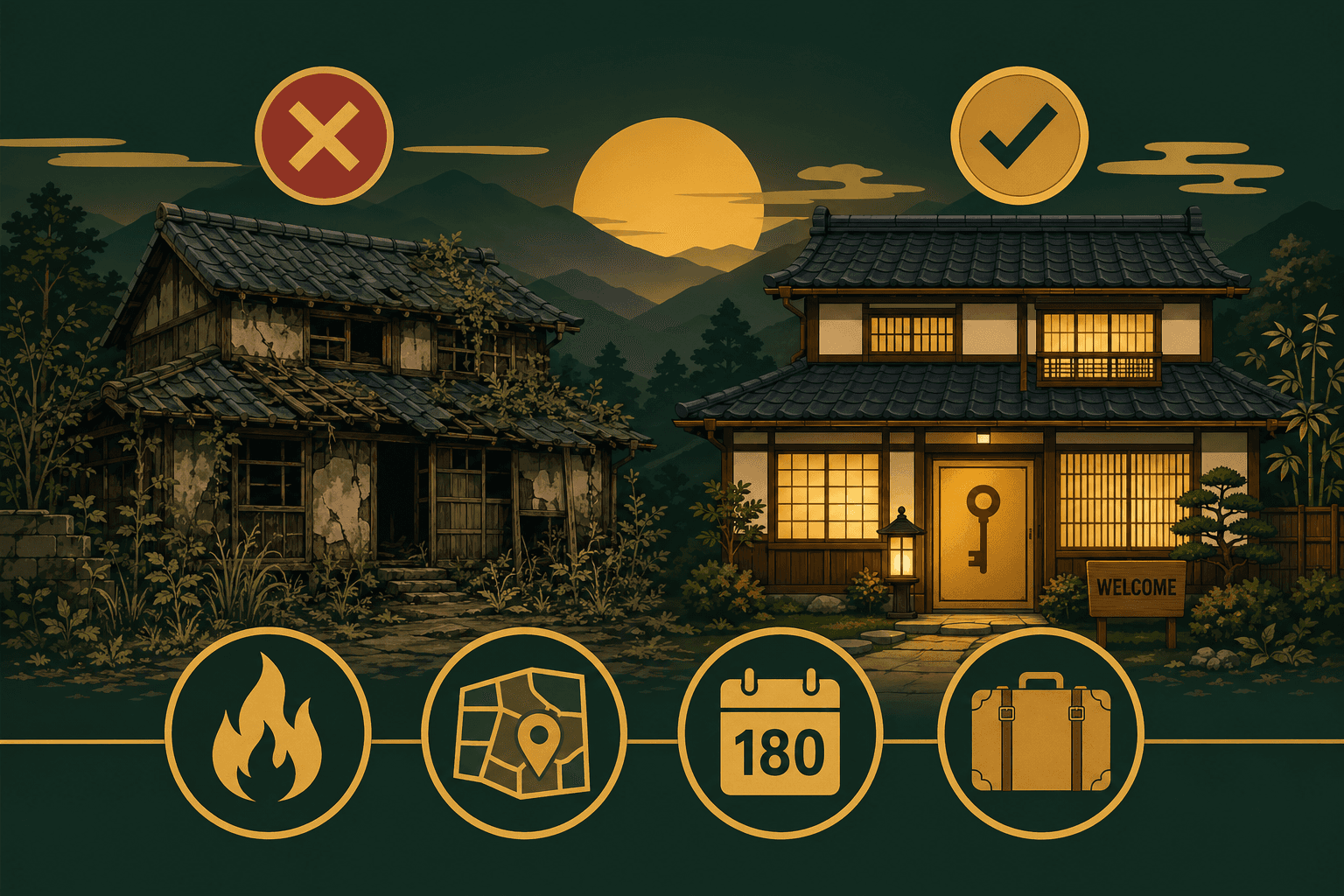
Most akiya don't qualify for year-round minpaku. Some qualify for 180 days a year. A smaller subset qualifies for 365 days under special zone rules — and a meaningful share cannot legally host paying guests at all without work that costs more than the house.
This guide covers the four barriers foreign buyers miss, which akiya profiles actually clear them, how the main minpaku-relevant cities compare, and how to verify a specific property before sending the deposit.
Why "Akiya × Airbnb" Sounds Like a Perfect Investment
The fantasy math is seductive: buy an akiya for ¥1,000,000, list it on Airbnb, collect tourism income in yen. Nightly rates of ¥8,000–¥30,000+ in tourist areas pay back the purchase price inside a single peak season.
That math assumes the house is legally and physically ready to host paying guests. It almost never is. What the Bloomberg headlines skip:
- The Minpaku Law (住宅宿泊事業法) caps residential-zone short-term rentals at 180 nights per calendar year — not 365.
- Most akiya are pre-1981 wooden structures that fail current fire and building-code requirements for accommodation use.
- In Kyoto and much of Tokyo, residential-zone minpaku is restricted to operating windows as narrow as 60 nights per year.
- Compliance renovation — detectors, emergency lighting, rated finishes, compliant egress — typically adds ¥2–8 million on top of standard livability renovation.
The ¥800,000 house becomes a ¥10 million project with a 180-day ceiling on operation in a thin off-peak market. That is the gap this article exists to close.
The 4 Barriers Foreign Buyers Miss
Four overlapping barriers decide whether a specific akiya can legally and profitably operate as a minpaku. Any one can be disqualifying on its own.
Barrier 1: Building Safety & Fire Code Compliance
The Minpaku Law treats your akiya as a lodging business, not a house. That triggers:
- Smoke detectors in every sleeping room and along escape routes
- Emergency lighting (誘導灯) guiding guests to exits
- Fire extinguishers sized to floor area
- Fire-resistant finishing on walls and ceilings (often required above 50㎡ or two stories)
- Compliant egress paths — unobstructed, marked, usable at night
Retrofitting a 60-year-old rural farmhouse to these standards typically runs ¥800,000–¥3,000,000, on top of the general akiya renovation costs for roof, plumbing, insulation, and wiring. Pre-1981 wooden structures frequently fail retardation requirements outright — complying means replacing interior finishes that were the reason the buyer fell in love with the house.
Barrier 2: Zoning (Residential vs Commercial vs Mixed)
Japanese cities sort land into zoning categories (用途地域). For short-term rental, three matter:
- Category 1 exclusive low-rise residential (第一種低層住居専用地域) — Minpaku is severely restricted or prohibited in many municipalities. Many rural and suburban akiya sit here.
- Residential with mixed use (住居地域, 準住居地域) — Minpaku generally allowed under the 180-day cap, often with added municipal constraints.
- Commercial / quasi-commercial (商業地域, 近隣商業地域) — Most favorable. 365-day exceptions and hotel-class licenses (旅館業法) are typically available only here.
Zoning maps are public. Before offering, pull the designation from the city's online zoning viewer (用途地域マップ). If the plot sits in Category 1 exclusive low-rise residential, assume minpaku is not viable until the specific municipality proves otherwise.
Barrier 3: The 180-Day Cap (住宅宿泊事業法)
A property registered as residential minpaku can legally host paying guests for a maximum of 180 nights per calendar year, enforced through mandatory bi-monthly reporting (定期報告). The 180-day cap is not absolute — three legal frameworks unlock 365-day operation, covered in Minpaku 180-Day Cap: Legal Paths to 365-Day Operation.
180 nights sounds workable, but lands hardest on rural properties where demand is seasonal:
- Tourism concentrates in 3–4 peak months (cherry blossom, autumn foliage, ski, summer festivals)
- Off-peak occupancy rarely exceeds 20–30%
- The 180 nights get consumed by peak demand before shoulder-season bookings would help
A Nagano mountain akiya might legally operate 180 nights and realistically see demand for 90–120. The property still pays 365 days of property tax, insurance, management, and utility carrying costs. Only properties inside National Strategic Special Zones or licensed under the separate Ryokan Business Act (旅館業法) escape the cap.
Barrier 4: Renovation Costs to Meet Minpaku Standards
The renovation bill stacks in layers:
| Layer | Typical Cost |
|---|---|
| General livability (roof, plumbing, insulation, electrical) | ¥3,000,000–¥10,000,000 |
| Seismic retrofit (pre-1981 buildings) | ¥1,000,000–¥5,000,000 |
| Fire and safety compliance for minpaku | ¥800,000–¥3,000,000 |
| Furnishing and guest-ready setup | ¥1,000,000–¥3,000,000 |
| Registration, floor plans, signage, manager contracting | ¥100,000–¥400,000 |
| Total (before purchase price) | ¥5,900,000–¥21,400,000 |
A ¥1,000,000 purchase becomes a ¥7–22 million project. At 180 nights with realistic occupancy and platform fees, payback commonly lands in the 8–15 year range — before any regulatory tightening or roof replacement. For city-by-city net yield numbers under both 180-day and 365-day frameworks, see Minpaku ROI 2026: Realistic Yields by Japanese City.
Which Akiya Actually Qualify
The qualifying population is smaller than most foreign buyers expect, but not zero. Four profiles consistently clear the barriers above.
Profile 1: Post-1981 Construction (新耐震基準)
June 1981 is the dividing line — Japan's new earthquake code took effect for permits issued from that date. Post-1981 akiya meet modern seismic standards without retrofit, insure at normal premiums, typically pass minpaku fire and structural requirements without major structural work, and resell to Japanese domestic buyers on exit.
They are rarer and more expensive than ¥500,000 headlines suggest — usually ¥3–10 million — but on a total-project basis they almost always undercut a ¥500,000 pre-1981 property once compliance costs are added.
Profile 2: Properties Already Certified for Hotel/Ryokan Use
A small number of akiya carry legacy certifications from former minshuku, pension, or small ryokan operations — retaining their hotel business license (旅館業法の許可). These:
- Are not subject to the 180-day cap — they operate under 旅館業法
- Already meet building-code requirements for accommodation use
- Can reopen as simple lodging (簡易宿所) with comparatively minor refurbishment
Usually located in established tourism corridors (Kyoto, Hakone, Karuizawa, Atami, hot-spring towns) and priced accordingly, but they sidestep the single most punishing barrier — the day cap.
Profile 3: Buildings in National Strategic Special Zones
Select municipalities permit year-round short-term rental under tokku minpaku (特区民泊). The flagship case is Osaka City, where large portions of the 24 wards allow 365-night operation with minimum-stay requirements (typically 2 nights, 3 days). Narrower tokku zones exist in Ota Ward (Tokyo), Kitakyushu, Niigata City, and parts of Chiba and Osaka Prefecture.
An akiya inside a tokku zone, meeting the scheme's minimum-stay and safety rules, can legally operate 365 days — radically changing the yield math versus a 180-day residential property.
Profile 4: Simple Lodging (簡易宿所) Candidates
The simple lodging license under the Ryokan Business Act is the most common route for foreign investors wanting 365-day operation outside tokku zones. It works for:
- Detached houses in commercial or quasi-commercial zones
- Properties with ≥33㎡ per accommodation unit (municipality-dependent)
- Buildings that can meet kitchen, bathroom, and fire-code standards for lodging
Licensing is stricter than residential minpaku registration — inspections are thorough, kitchen and bathroom specs are specific, fire-code enforcement is real. But once licensed, there is no day cap. Many successful foreign-operated akiya conversions use this route.
City-by-City Feasibility
Location changes everything. The same akiya structure can be a viable 365-day business in one city and an illegal listing in another.
Osaka — Special Zone Advantage
Osaka is the clearest bright spot. Large portions of Osaka City sit inside the tokku minpaku zone, allowing 365-day operation with a 2-night minimum. Universal Studios, Dotonbori, the business district, and Kansai International Airport keep occupancy above national averages across all seasons.
- Central wards (Chuo, Kita, Naniwa, Nishi) are the most attractive but have almost no akiya supply
- Outer wards (Nishinari, Ikuno, parts of Higashinari) have real akiya supply in the ¥3–8 million range and still sit inside the tokku zone
- Tokku boundaries run street-by-street, not by ward — verify the specific plot
- Sanity-check asking prices against the Namba / Shinsaibashi transaction data
Osaka is the only major Japanese city where "akiya for Airbnb" describes a realistic investment pattern at scale.
Kyoto — Machiya Akiya Strict Rules
The opposite extreme. Kyoto's 2018 ordinance restricts residential-zone minpaku to January 15 – March 16 only — approximately 60 operating nights per year, concentrated in the weakest-demand season.
For a classic machiya (町家) akiya the realistic paths are:
- Simple lodging license in a commercial or quasi-commercial zone, usually requiring substantial structural work
- Hotel / ryokan license under 旅館業法 — typically ¥30–100 million of capital for a viable small operation
- Long-term rental or personal use — not short-term rental at all
Machiya face additional layers: the Kyoto Landscape Ordinance constrains exterior changes, preservation districts limit rebuild options, and traditional-structure fire compliance adds ¥3–8 million of hidden modern reinforcement. See the Kyoto market guide and Central Kyoto transaction data for broader context. Machiya are extraordinary lifestyle assets; they are rarely viable minpaku investments.
Fukuoka — Kyushu Opportunity
Fukuoka sits between Osaka and Kyoto in regulatory intensity. Not a tokku zone, so 180 days applies in residential areas — but:
- Zoning and building stock include a meaningful share of commercial-zone detached houses eligible for simple-lodging licensing
- Tourism demand is growing fast, driven by Korean and Taiwanese inbound, Hakata bullet-train connectivity, and the city's young demographic
- Purchase prices sit materially below Osaka central wards — akiya and near-akiya properties appear at ¥5–15 million in commercial-adjacent zones
- Registration is comparatively efficient for foreign applicants with a licensed local manager
A credible second-tier choice after Osaka when the budget falls short of Osaka central-zone pricing. Cross-reference the Hakata and Tenjin / Daimyo pages.
Rural Japan — 180-Day Cap + Thin Demand
The "cheap countryside akiya on Airbnb" thesis hits two walls simultaneously:
- The 180-day cap binds hardest where demand is seasonal. A ski-area akiya that can legally run 180 nights realistically books 60–100. A coastal akiya in Shikoku might see 40–60 peak nights.
- Residential-only zoning is the rural default. Year-round simple-lodging licensing is hard or impossible to obtain.
Exceptions exist — established ski corridors (Niseko, Hakuba, Nozawa Onsen) and Okinawa beach zones (Ishigaki, Miyakojima) — but they are well-known and priced accordingly. The ¥500,000 deals are in areas where minpaku does not meaningfully work. The best akiya areas ranking separates regions where demand and appreciation hold up from those where they do not.
Due Diligence Checklist Before Buying
A nine-point verification pass, completed before offering, rules out the most expensive akiya-for-minpaku mistakes.
- Zoning designation (用途地域) — Pull the official zoning map for the exact plot. Confirm minpaku and simple-lodging are permitted in that category under current municipal rules.
- Tokku minpaku status — If you need 365-day operation, verify the plot sits inside the National Strategic Special Zone using the city's official map, not secondhand references.
- Building construction date (建築年月日) — Pull from the property registry (登記簿 / tōkibo). Pre-1981 triggers seismic retrofit and complicates insurance.
- Existing certifications — Check whether the property ever held a hotel business license (旅館業法の許可) that may be grandfathered or reactivatable.
- Floor area and unit configuration — Confirm minimum-area requirements for your target license class (typically 25–50㎡ depending on municipality).
- Fire code baseline — Commission a pre-purchase inspection specifically for minpaku compliance, not just habitability. ¥50,000–¥150,000 and it separates buyable properties from money pits.
- Condominium bylaws (管理規約) — If the akiya is inside a condo, approximately 99% of bylaws prohibit minpaku regardless of national or municipal law. See the parent minpaku rules article.
- MLIT transaction comparables — Cross-reference asking price against actual completed transactions in the same municipality. For akiya specifically the asking-vs-sold gap widens to 15–40% in high-vacancy prefectures — see our akiya MLIT transaction price analysis. For the broader urban-and-resort gap, see Japan property asking vs sold price.
- Local manager availability — Non-resident owners must appoint a licensed residential lodging property manager (住宅宿泊管理業者). Confirm a manager is available in the town and obtain a written fee quote (typically 20–30% of revenue) before closing.
For broader due diligence beyond minpaku — title, encumbrance, tax — see the foreign buyer due diligence checklist.
Considering a specific akiya for minpaku? A JRE Price Check Report ($49) verifies zoning, MLIT transaction comparables, and minpaku viability on the exact address before you commit. Limited free interview slots are available through May 31 for investors at the contract stage with a specific property under consideration. Start a Price Check →
When Akiya Doesn't Qualify — 3 Alternatives
If the property fails one or more of the nine checks and retrofitting is not economic, three alternatives preserve most of the upside without the regulatory burden.
1. Long-term rental (賃貸). Sidesteps every minpaku constraint — 180-day cap, zoning, fire code, manager licensing. For rural akiya, long-term demand is thin but real; for near-urban akiya, ¥40,000–¥90,000 monthly rents often outperform marginal minpaku operations after costs and vacancy. See the rental yields by area guide.
2. Vacation home for personal use. Many foreign buyers frame the purchase as investment, but the real value is personal — a weekend home, a retirement base. Removing the revenue requirement eliminates the regulatory and renovation cost stack; only livability renovation remains.
3. Resell after partial renovation. Buy at a discount, complete a structurally sound but cosmetically modest renovation, exit to a Japanese domestic buyer. Works where land values are stable or rising — see the best akiya areas ranking for regions that support this exit.
How to Verify a Specific Property
For a target akiya you are seriously considering, three verification steps confirm what the listing agent says.
Step 1 — MLIT transaction data lookup. MLIT publishes actual completed transaction records by municipality and quarter. Pull the last 8 quarters for the target municipality, filtered to similar property type. Fewer than 5 transactions means the local market is thin — a liquidity warning in itself.
Step 2 — Local government zoning and minpaku confirmation. Most municipalities now publish online zoning viewers and minpaku-permitted-zone maps. For the plot's exact address, confirm the 用途地域, whether 住宅宿泊事業 is permitted, and — if targeting 365-day operation — tokku boundaries or simple-lodging eligibility. A call to the municipal building department (建築指導課) with an interpreter resolves the rest.
Step 3 — Minpaku registration status check. The Japan Tourism Agency (観光庁) publishes the national minpaku registration database. Search the address — if already registered, confirm the registration is current and transferable. If not, starting operations requires fresh registration including floor plans, manager contracting, and neighbor notification.
These three steps take one day and replace roughly 80% of the assumptions foreign buyers carry into an akiya-for-minpaku purchase.
The investors who succeed with akiya-for-minpaku treat the purchase as a regulated small-business acquisition, not a lifestyle impulse. The math works — in Osaka tokku zones, in Fukuoka commercial-adjacent plots, in post-1981 properties with existing simple-lodging licenses. It rarely works in a pre-1981 rural wooden house bought for symbolic money and posted on Airbnb.
If you have a specific property in mind and want the nine-point verification run against the exact address — zoning, MLIT comparables, minpaku viability, and estimated total-project cost — the JRE Price Check Report delivers it in a single ¥-priced deliverable for $49. For broader area comparisons across Osaka, Fukuoka, Kyoto, and Niseko, the $19 Location Data pages surface the transaction records that ground every feasibility estimate in this article.
Start a Price Check for a specific akiya →
Frequently Asked Questions
Can I legally run Airbnb from an akiya in Japan?
Sometimes. It depends on the zoning category, construction date, fire-code compliance, and whether the building sits inside a National Strategic Special Zone. A post-1981 detached house in an Osaka tokku zone with a licensed manager can legally operate 365 days. A pre-1981 wooden house in a rural residential-only zone typically cannot operate as a minpaku without significant retrofit, and is capped at 180 nights in any case.
What does minpaku registration cost for an akiya?
Registration fees are inexpensive — roughly ¥50,000–¥200,000 for filings, floor plans, and signage. The real cost is reaching registration-eligible condition: fire and safety compliance (¥800,000–¥3,000,000), furnishing and guest-ready setup (¥1,000,000–¥3,000,000), and seismic work for pre-1981 buildings (¥1,000,000–¥5,000,000). Total project cost from purchase to first guest night commonly runs ¥6–20 million on top of the purchase price.
Which Japanese cities allow year-round akiya minpaku?
The clearest 365-day route is inside designated tokku minpaku zones — the largest is in Osaka City, with narrower zones in Ota Ward (Tokyo), Kitakyushu, Niigata City, and parts of Chiba. Outside tokku zones, 365-day operation is possible only through simple-lodging (簡易宿所) or full hotel (旅館業法) licensing, generally limited to commercial or quasi-commercial zones. Residential-zone minpaku is capped at 180 nights nationally and often lower under municipal ordinances — Kyoto restricts residential operation to roughly 60 nights per year.
Do foreign non-residents need a local representative for minpaku?
Yes. Under the Residential Lodging Business Act, any owner not physically present must appoint a licensed residential lodging property manager (住宅宿泊管理業者) to handle check-in, emergency response, neighbor liaison, and bi-monthly reporting. Non-resident foreign owners effectively always require a manager. Fees typically run 20–30% of revenue. Operating without a licensed manager is grounds for registration revocation.
Related Articles
- Japan Short-Term Rental (Minpaku) Rules 2026 — Parent article on the full national and municipal framework
- Minpaku 180-Day Cap: Legal Paths to 365-Day Operation — 特区民泊, 旅館業, and 簡易宿所 explained
- Minpaku ROI 2026: Realistic Yields by Japanese City — Realistic net yields after the 180-day cap, withholding, and management
- Minpaku Tax Guide for Non-Resident Owners (2026) — 20.42% withholding mechanics, depreciation, and treaty positions
- Pre-1981 Akiya Risk 2026: Why 60%+ Fail Modern Earthquake Code — The structural-code obstacle that disqualifies most akiya from minpaku before fire-safety even applies
- Akiya Renovation Costs 2026: Real Examples by Region — Line-item costs including the ¥2.3M–¥6.2M minpaku conversion adders
- Japan's 9 Million Vacant Houses 2026: Government Data — The full size of the akiya inventory and what's coming by 2030/2040
- Are Akiya Really Cheap? Government Data on True Cost — Renovation and carrying-cost breakdown that applies to every akiya purchase
- The Hidden Costs of "¥0 Akiya" for Foreign Buyers — Six hidden cost categories and three real total-cost scenarios
- Akiya Actual Transaction Prices: MLIT vs Suumo — The 15–40% asking-vs-sold gap that decides whether your underwriting is realistic
- Best Akiya Areas in Japan: Data-Driven Ranking — Which akiya regions have rising land values and real demand
- Can Foreigners Buy Property in Japan? Complete Guide — Foundational ownership rules for non-resident buyers
- Japan Banks & Mortgages for Foreign Buyers 2026 — Cash-buy vs financing for akiya-scale purchases
- Japan Property Ownership Costs: Monthly & Annual — Fixed carrying costs that apply whether rented or vacant
- Foreign Buyer Due Diligence Checklist — Broader title, tax, and encumbrance checks beyond minpaku specifics
Disclaimer
This article provides general information on akiya investment in the context of Japan's short-term rental regulations and should not be treated as legal, tax, or investment advice. Zoning designations, municipal ordinances, and minpaku registration requirements change frequently and vary by location and property type. Always verify current regulations with the relevant local government office (市町村役場), confirm the specific zoning of the target plot, and consult a qualified Japanese attorney or licensed real estate professional before purchasing any akiya for short-term rental purposes.