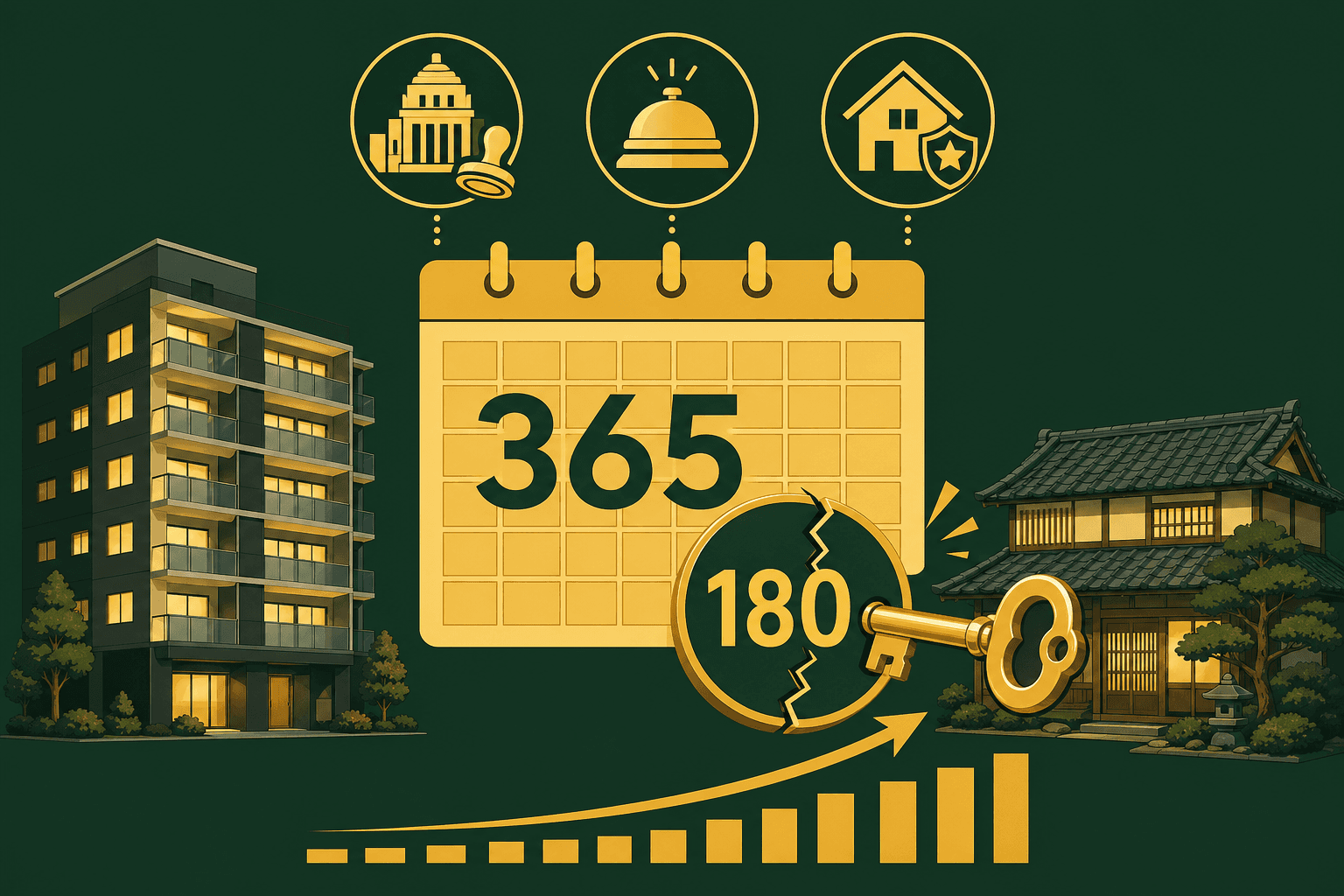
The 180-day cap under the 2018 住宅宿泊事業法 (Minpaku Law) is the most-cited limit on short-term rentals in Japan — but it is not the only regulatory framework available. Investors who want year-round operation have three legitimate paths, each with its own requirements, costs, and geographic availability.
This guide walks through all three legal routes to 365-day operation, lists every zone that currently allows it, and compares costs, timelines, and compliance burdens so foreign owners can make an informed decision before buying.
TL;DR
The 180-day cap under 住宅宿泊事業法 is a ceiling that applies to one of three short-term rental frameworks. Three alternatives allow 365-day operation:
- 特区民泊 (National Strategic Special Zone minpaku) — only in designated zones (Osaka City, Tokyo Ota-ku, Kitakyushu, certain Niigata and Chiba areas). 2-night minimum stay. Easiest path to 365 days if your property is in a designated zone.
- 旅館業法 / 簡易宿所 (Simple Lodging) — the lightest category under the Hotel Business Law. No day limit, no minimum stay. Available nationwide but requires zoning approval, fire safety compliance, and a stricter facility standard.
- 旅館業法 / 旅館・ホテル (Full Ryokan or Hotel license) — the oldest and most powerful framework. No day limit. Used for dedicated lodging businesses, machiya conversions, and purpose-built guesthouses.
The right path depends on your target city, property type, and willingness to invest in compliance. Osaka-focused investors should almost always look at 特区民泊 first. Nationwide operators typically pursue 簡易宿所.
The 180-Day Problem Explained
Why the cap exists
When Japan legalized short-term rentals in June 2018, the goal was to bring an unregulated Airbnb market into compliance without cannibalizing the domestic hotel industry. The 180-day ceiling — set in Article 2 of the 住宅宿泊事業法 — was a political compromise: enough room for homeowners to rent occasionally, not enough for most properties to become full-time rental businesses.
The law also lets municipalities impose stricter limits via local ordinance (条例), which many major cities have done. In practice, a "180-day license" often delivers far fewer operable days than the name suggests.
Who it applies to
The 住宅宿泊事業法 framework is the only framework that has the 180-day ceiling. If you register under this law, you are capped — full stop.
The cap does not apply to:
- Facilities licensed under the 旅館業法 (Hotel Business Law), including 簡易宿所 (Simple Lodging)
- Facilities operating under the 国家戦略特別区域法 (National Strategic Special Zones Act) — i.e., 特区民泊
In other words, the 180-day limit is a feature of one specific license category, not of Japanese short-term rental law in general.
The economic impact on yield
For a typical Tokyo or Osaka condo operating at ¥15,000/night, the 180-day cap puts a hard ceiling on gross revenue around ¥2.0–2.2 million per year — before platform fees, cleaning, and management. After costs, net income often lands within the range of a conventional long-term lease, which is why so many foreign investors who bought "for Airbnb" later pivot to monthly rentals. For city-by-city net yield numbers under both 180-day and 365-day frameworks, see our Minpaku ROI 2026: Realistic Yields by Japanese City analysis. For a more general yield walkthrough, see our Japan Rental Yields by Area analysis and the cap-rate and yield metrics guide.
The economics only change materially when you unlock all 365 days — which requires one of the alternative frameworks below.
The Three Legal Paths to Year-Round Operation
Path 1: National Strategic Special Zones (特区民泊)
特区民泊 (tokku minpaku) is a short-term rental framework created under the 国家戦略特別区域法 (National Strategic Special Zones Act). It is a separate legal authority from the 住宅宿泊事業法 and is not subject to the 180-day cap.
Key features:
- No annual day limit — 365-day operation is legal from day one
- 2-night minimum stay (2泊3日) enforced at the national level in most designated zones
- Residential-zoned buildings are acceptable — you do not need commercial zoning
- Operator must obtain certification (認定) from the designated municipality, not just a notification (届出)
- Building bylaws (管理規約) still apply — if the condo association prohibits short-term rentals, 特区民泊 certification will not override that
Registration process for foreign owners involves: submitting facility plans, confirming fire safety compliance, notifying neighbors (近隣説明) in advance, and providing a designated management contact reachable 24/7. Most certifications run 6–8 weeks end-to-end in Osaka; other zones can be slower.
The catch: 特区民泊 only exists where it has been designated. As of 2026, that list is short (see "Which Zones Allow 365-Day Minpaku" below).
Path 2: Full Hotel or Ryokan Business License (旅館業法)
The 旅館業法 (Hotel Business Law) predates the minpaku framework by decades. It was substantially reformed in June 2018 — the same month the Minpaku Law took effect — which merged the old "hotel" and "ryokan" categories into a unified 旅館・ホテル営業 license and kept 簡易宿所営業 (Simple Lodging) as a separate lighter-weight category.
Characteristics of the full 旅館・ホテル license:
- No annual day limit, no minimum stay
- Zoning: property must be in a zone where lodging businesses are permitted (商業地域, 近隣商業地域, and certain other zones)
- Building requirements: commercial-grade fire/safety compliance, accessibility features, and ventilation standards
- Front desk: generally required, though ICT-based remote check-in has been permitted in many municipalities since 2018
This category is typically used by dedicated lodging businesses — converted machiya, purpose-built guesthouses, small hotels — rather than by foreign investors buying a single condo unit. Setup costs frequently exceed ¥5 million once building modifications are included.
Path 3: Simple Lodging Category (簡易宿所)
簡易宿所営業 is the accessible subset of the 旅館業法 framework and is where most serious year-round operators outside of 特区民泊 zones end up.
Key features:
- No annual day limit, no minimum stay
- Nationwide availability, subject to zoning
- Floor-area rule: 33㎡ total (or 3.3㎡ per guest if maximum capacity is under 10) — originally intended for hostels and guesthouses, it fits smaller properties that cannot meet full-ryokan standards
- Bathroom / toilet: at least one each per facility; shared facilities are permitted
- Fire safety: full fire safety compliance is required (自動火災報知設備, 誘導灯, 消火器, etc. depending on scale)
- Front desk / staffing: the 2018 reform expressly allows remote check-in via ICT if specific conditions are met — including real-time guest identity verification, 24/7 rapid response within ~10 minutes, and a contact point filed with the保健所 (Public Health Center)
Simple Lodging is the path of choice for:
- Guesthouses and hostels
- Kyoto machiya conversions
- Single-building small-scale operators in non-特区 cities (Tokyo outside Ota-ku, Fukuoka, Nagoya, Sapporo, etc.)
The Decision Matrix
| Factor | 住宅宿泊 (Minpaku Law) | 特区民泊 | 旅館業 (簡易宿所) |
|---|---|---|---|
| Annual operating days | 180 max | 365 | 365 |
| Minimum stay | None | 2 nights | None |
| Area availability | Nationwide | Designated zones only | Nationwide (zoning required) |
| Building zoning | Residential OK | Residential OK | Commercial or mixed-use |
| Fire safety standard | Light | Medium | Heavy |
| Neighbor notification | Required | Required | Not required (but recommended) |
| License / certification fee | Free (届出 only) | ~¥21,000 | ~¥22,000 |
| Time to obtain | 2–4 weeks | 6–8 weeks | 3–6 months (incl. modifications) |
| Ongoing compliance | Light (bi-monthly reporting) | Medium | Heavy |
| Condo bylaw override | No | No | No |
All three still respect the building's 管理規約 (management bylaws). For condos, this is almost always the decisive constraint — roughly 99% of condo associations prohibit short-term rental regardless of which national framework you use. See the parent minpaku rules guide for the full three-layer framework.
Free due-diligence checklist (PDF)
Before you trust a 16% yield — run the 7-layer check
The due-diligence checklist we built investigating a real high-yield listing in Japan — including the land-registry check that changed the deal. Free PDF, sent to your inbox.
No spam. Unsubscribe anytime in any email.
Which Zones Allow 365-Day Minpaku
Osaka (the flagship 特区民泊 market)
Osaka Prefecture and Osaka City were the earliest and most aggressive adopters of 特区民泊. The program covers the entire city of Osaka (大阪市全域) plus several designated municipalities in Osaka Prefecture.
Why Osaka is the #1 destination for serious minpaku investors:
- Entire-city designation — most condo locations qualify geographically
- Mature operator and management-company ecosystem in both Japanese and English
- Strong underlying tourism demand in Minami, Umeda, and the coastal ward around USJ
- Lower property prices than Tokyo drive higher cash-on-cash returns even with the 2-night minimum
For investors exploring Osaka property with 365-day intent, see our area guides for Namba and Shinsaibashi, Umeda, and the comparative Tokyo vs Osaka investment analysis. Live transaction data and asking-price context for each area are available on the location pages under /locations/namba-shinsaibashi and /locations/umeda-kita.
View real transaction prices, price trends, and investment analysis for Osaka Namba / Shinsaibashi based on MLIT government data.
Explore Osaka Namba / Shinsaibashi Data →View real transaction prices, price trends, and investment analysis for Osaka Umeda / Kita based on MLIT government data.
Explore Osaka Umeda / Kita Data →Tokyo: Ota-ku (and why the rest of Tokyo does not qualify)
Despite Tokyo's size, only Ota-ku (大田区) has 特区民泊 designation — introduced in 2016, before the national Minpaku Law existed. The other 22 special wards operate under the 180-day framework and, in many cases, impose additional weekends-only restrictions on top of that.
Ota-ku's attraction for investors:
- Adjacent to Haneda Airport, which drives consistent year-round demand from short-stay international and domestic business travelers
- Lower entry prices than central Tokyo wards
- Established 特区民泊 operator base, making management outsourcing realistic
One frequently misunderstood point: Chiyoda-ku, Minato-ku, and Shibuya-ku are not 特区民泊 zones. Operating year-round in those wards requires Simple Lodging or a full hotel license — with correspondingly higher zoning and fire-safety hurdles.
Kitakyushu (Fukuoka area)
The city of Kitakyushu, in Fukuoka Prefecture, is a designated 特区民泊 zone. It is meaningfully smaller than Osaka in terms of tourist volume, but it is the only 特区 designation in the Kyushu region and has active operators. Fukuoka City itself is not a 特区民泊 zone, so investors there typically use Simple Lodging — see our Fukuoka Hakata area investment guide and Fukuoka Tenjin guide for the underlying market context, and /locations/hakata-tenjin for transaction data.
View real transaction prices, price trends, and investment analysis for Fukuoka Hakata based on MLIT government data.
Explore Fukuoka Hakata Data →View real transaction prices, price trends, and investment analysis for Fukuoka Tenjin based on MLIT government data.
Explore Fukuoka Tenjin Data →Other designated zones
Several other areas have special-zone designations that include or overlap with 特区民泊 provisions, though practical operator activity varies:
- Niigata City — limited designated areas
- Chiba City — limited designated areas (primarily commercial/tourism zones)
- Yabu (Hyogo) — rural revitalization overlay
- Sendai and Senboku (Akita) — special zones with selective short-term rental provisions
If you are considering a property outside Osaka, Ota-ku, or Kitakyushu, always verify the current designation with the target municipality before relying on 365-day operation in your underwriting. Special-zone coverage can be amended, and municipalities occasionally narrow the designated areas over time.
Requirements for Each License Type
特区民泊 Facility Requirements
- Floor area: typically 25㎡ minimum per unit (varies slightly by municipality; Osaka's ordinance specifies 25㎡)
- Minimum stay: 2 nights (2泊3日) enforced at booking level — platforms must prevent 1-night bookings
- Fire safety: smoke detectors, fire extinguishers, emergency lighting, and a posted evacuation plan
- Neighbor notification: written notice delivered to adjacent units and the building association before certification is granted
- Management contact: must be reachable 24/7 and able to arrive on-site within a specified window
Foreign owners do not need to be Japanese residents, but they must designate a qualifying local management representative (住宅宿泊管理業者 or equivalent under 特区 rules).
簡易宿所 Specifics
- Zoning: operation is permitted in most zones other than pure residential (第一種低層住居専用地域). Verify with the city planning division before purchase — this is the single most common reason 簡易宿所 applications fail
- Room specifications: 33㎡ total floor area minimum, or 3.3㎡ per guest at maximum capacity under 10 guests
- Fire safety: automatic fire alarm (自動火災報知設備) mandatory above certain building sizes, plus 誘導灯 (guide lights), 消火器, and compliance with the Fire Service Act (消防法)
- Front desk: physical presence is the default, but ICT check-in systems are widely accepted as of 2026 if identity verification and 10-minute emergency response are guaranteed
- Building code: properties built before major Building Standards Act reforms may require retrofits, especially for escape routes and interior finish materials
Common qualifying properties: guesthouses, traditional machiya, small detached houses in commercial-adjacent zones, and converted small apartment buildings. Common disqualifiers: condo units bound by management bylaws, properties in strict residential-only zones, and buildings whose ceiling heights or escape routes fall below commercial-lodging code.
Cost & Timeline Estimates
Initial Setup Costs by Path
| Cost category | 住宅宿泊 (180 days) | 特区民泊 | 簡易宿所 |
|---|---|---|---|
| Government fees | ¥0 (届出 only) | ~¥21,000 | ~¥22,000 |
| Fire safety equipment | ¥30,000–100,000 | ¥100,000–300,000 | ¥200,000–800,000 |
| Building modifications | Minimal | Light | ¥0–2,000,000+ (property-dependent) |
| Furnishing / setup | ¥1,000,000–3,000,000 | ¥1,000,000–3,000,000 | ¥1,500,000–4,000,000 |
| Administrative / consulting | ¥50,000–200,000 | ¥150,000–400,000 | ¥300,000–800,000 |
| Typical all-in range | ~¥50K–200K + furnishing | ~¥150K–400K + furnishing | ~¥500K–2M + furnishing |
Numbers exclude real-estate purchase costs. For a full buying-side breakdown, see our property buying costs guide and property tax guide. For non-resident-specific operating-period taxation — the 20.42% withholding, depreciation strategy, consumption tax thresholds, and treaty positions for US/UK/Singapore/Hong Kong owners — see our Minpaku Tax Guide for Non-Resident Owners (2026).
Ongoing Compliance Costs
- 住宅宿泊: bi-monthly reporting to the 観光庁 via the online system (minpaku.mlit.go.jp); light annual cost
- 特区民泊: reporting to the certifying municipality on a schedule it sets; insurance tailored to 特区 operation typically adds ¥30,000–80,000/year
- 簡易宿所: annual保健所 inspections, fire marshal inspections every 3 years, and full commercial lodging liability insurance (often ¥80,000–200,000/year)
Simple Lodging is also classified as a commercial business, which changes tax treatment: the property becomes a business asset subject to 事業税 considerations, and depreciation rules differ from residential rental. Foreign owners structuring through a company should additionally consider FEFTA reporting implications — see our 2026 foreign investor reporting law guide and FEFTA Form 22 filing walkthrough for details.
When to Choose Which Path
A practical decision framework:
- Your property is a single condo unit in a typical building → short-term rental is almost certainly not viable under any framework, because condo 管理規約 usually prohibits it. Long-term rental is the realistic path. Review our condominium law changes guide for context on how bylaw governance is evolving.
- Your property is in Osaka City, Ota-ku, or Kitakyushu and the building bylaws allow short-term rental → 特区民泊 is almost always the right choice. 365 days, residential zoning OK, moderate cost.
- Your property is a detached house or whole building in a tourist city outside 特区 zones → Simple Lodging is the right target. Plan for ¥500K–2M in compliance setup and a 3–6 month timeline.
- You are building or converting a dedicated lodging business (multiple rooms, purpose-built guesthouse) → the full 旅館業 license may make sense. Only pursue this if yield justifies the compliance burden.
- You operate occasionally and are willing to accept the 180-day cap → the 住宅宿泊事業法 届出 is the simplest path — though, again, confirm your building bylaws allow it first.
Foreign Owner-Specific Considerations
Tax representative
A non-resident owner generating rental income in Japan must designate a 納税管理人 (tax administrator) under the 国税通則法. This is required regardless of which framework you use, but the reporting is more involved for 簡易宿所 / full 旅館業 because the income is classified as business income, not real-estate income.
Local representation
特区民泊 and 住宅宿泊事業法 both require a qualifying management contact reachable 24/7. You do not have to be the contact yourself, but you must formally designate one — either an individual representative or a licensed 住宅宿泊管理業者. Foreign passports are not a barrier; what matters is that the contact is reachable in Japan.
Bank account for receiving payments
Airbnb and other platforms can remit to foreign bank accounts, but having a domestic JPY account simplifies operations, cleaning-company payments, utility setup, and tax reporting. If you do not yet have one, see our remote buying guide and the country-specific guides for US and Singapore investors.
Insurance in English
Standard residential fire insurance typically excludes short-term rental use. Any of the three frameworks requires a rider or a separate commercial lodging liability policy. A few major insurers and several English-speaking brokers offer lodging-operator policies priced around ¥80,000–200,000/year for a single small unit, scaling with capacity and structure type.
FEFTA classification for 旅館業
Commercial lodging assets can fall under different FEFTA notification categories than passive residential investments. Owners acquiring or contributing capital to a 旅館業-licensed entity should confirm the exact notification category before purchase or structural change. Our 2026 FEFTA reporting update explains the current notification triggers.
Common Mistakes That Invalidate Your License
- Operating before formal approval. 届出 under the Minpaku Law takes effect on a specific date; certification under 特区 or 旅館業 takes effect when the certificate/license is issued. Accepting bookings before that date — even if the property is "ready" — is illegal operation and grounds for rejection.
- Misrepresenting building zoning. If 簡易宿所 is granted on an application that misstates the zone, and the city later confirms the property is in 第一種低層住居専用地域, the license is revocable.
- Building modifications without permit. Converting a condo into a lodging configuration (front desk area, fire-rated doors, sprinklers) requires building permits. Proceeding without them can invalidate both the lodging license and the property's certificate of compliance (検査済証).
- Failing to notify neighbors. 特区民泊 and Minpaku Law registrations both require written notice to adjacent units and the management association. Skipping this is the most common reason certifications are revoked after complaints.
- Guest registration lapses. All three frameworks require guest identity records (氏名・住所・国籍・旅券番号) retained for a set period. Platform auto-check-in does not satisfy this on its own — the operator is responsible.
- Operating a "住宅宿泊" property for 181+ days. The 住宅宿泊事業者 is required to submit bi-monthly reports; exceeding 180 days in a calendar year is visible in the reporting system and triggers suspension.
Frequently Asked Questions
Can I legally operate a minpaku for 365 days in Japan?
Yes — but only under the right license. The 180-day cap applies specifically to the 住宅宿泊事業法 framework. Operating under either the 国家戦略特別区域法 (特区民泊) or the 旅館業法 (simple lodging or full ryokan/hotel license) removes the annual day limit. Geographic availability and building requirements differ between the three, so the practical question is which framework your property can qualify for.
What is 特区民泊 (special zone minpaku)?
特区民泊 is a short-term rental framework created under the National Strategic Special Zones Act. In designated zones — Osaka City, Tokyo Ota-ku, Kitakyushu, and several smaller areas — properties can operate 365 days per year under a certification (認定) regime separate from the Minpaku Law. A 2-night minimum stay applies, and the property must still comply with building bylaws and fire safety requirements.
Which Japanese cities allow year-round short-term rental under 特区民泊?
As of 2026, the main 特区民泊 cities are Osaka (entire city and several municipalities in Osaka Prefecture), Tokyo's Ota-ku, and Kitakyushu. Smaller designations exist in parts of Niigata, Chiba, Yabu, and other special zones. Outside these areas, 365-day operation generally requires a license under the 旅館業法 — typically 簡易宿所 for small-scale properties.
Is the ryokan license worth pursuing for foreign owners?
The full 旅館・ホテル license is worth pursuing only when the property's scale and yield justify the compliance investment — typically dedicated guesthouses, small hotels, or multi-room conversions. For a single-unit investor, the 簡易宿所 category within 旅館業法 is almost always the right target if 特区民泊 is not available. Setup costs for 簡易宿所 typically run ¥500K–¥2M plus furnishing, and the license permits 365-day operation with no minimum stay.
How long does it take to get a 旅館業 license?
For 簡易宿所, the realistic end-to-end timeline is 3–6 months. This includes preliminary consultation with the 保健所 (Public Health Center), zoning confirmation with city planning, fire-safety inspection, any required building modifications, and the final license issuance. Full 旅館・ホテル licenses typically take longer, especially if building modifications or use-change permits are required. 特区民泊 certification, by contrast, typically takes 6–8 weeks in Osaka.
Does 特区民泊 override a condominium's management bylaws?
No. All three frameworks — Minpaku Law, 特区民泊, and 旅館業 — require compliance with the building's 管理規約. If the condominium association has prohibited short-term rental, no national or special-zone license will override that prohibition. For foreign investors buying a condo with short-term rental intent, written confirmation from the management association is the first due-diligence step.
Can I run a 特区民泊 remotely from overseas?
You can own the property from overseas, but you must designate a qualifying local management contact reachable 24/7. This is typically a licensed 住宅宿泊管理業者 or a 特区-approved operator. Remote ownership works well in practice when you have a competent local partner; managing the regulatory interface yourself from overseas is not realistic.
After I get the license, who manages the property day-to-day?
Once the license or certification is granted, the operating work begins — and for a non-resident owner it falls to a management company. Day-to-day operation means cleaning turnovers, guest communication and identity verification, 24/7 emergency response, neighbor relations, restocking, and bi-monthly regulatory reporting. A registered 住宅宿泊管理業者 typically charges 15–25% of revenue plus per-turnover cleaning fees. For the full operating workload and cost breakdown, see The Real Work of Running a Minpaku in Japan.
Next Steps: From License Path to Actual Numbers
Picking the right legal framework is step one. Step two is running the numbers for your specific city — because the structural advantage of 365-day 特区民泊 only matters if the property's ADR, occupancy, and entry price actually work after 20.42% non-resident withholding and 25–30% management overhead.
The honest sequence:
- Confirm which path your property qualifies for (this guide).
- Run city-specific net yield math — see Minpaku ROI 2026: Realistic Yields by Japanese City for Osaka 8–12%, Fukuoka 7–10%, Tokyo 5–7%, Kyoto 3–5%, and the operating-cost framework that turns gross into net.
- Validate against MLIT comparables — pull recent transaction prices for the exact building or block via the Locations data.
- Pressure-test for compliance risk — building bylaws, ward-level ordinances, fire-safety retrofit requirements specific to your candidate property.
Considering a specific property for 365-day operation? The feasibility depends on the exact zone, building bylaws, and facility specifics of that property — and getting those details wrong can invalidate the economics. Our Price Check Report ($49) reviews a target property's location data, transaction history, and regulatory context so you can confirm which license path is realistically available before you commit capital.
For broader investment-strategy context before choosing a city, the Japan vs Singapore, Japan vs USA, and Tokyo vs Osaka comparisons are useful starting points.
Related Articles
- Japan Short-Term Rental (Minpaku) Rules 2026 →
- The Real Work of Running a Minpaku: Costs & Management →
- Minpaku ROI 2026: Realistic Yields by Japanese City →
- Minpaku Tax Guide for Non-Resident Owners (2026) →
- Akiya for Minpaku 2026: Which Vacant Homes Qualify for Airbnb →
- Japan Rental Yields by Area: Government Data Analysis →
- Japan Property Tax Guide for Foreign Investors →
- Japan 2026 Foreign Investor Reporting Law →
- FEFTA Form 22 Filing Guide →
- Japan Condominium Law Changes 2026 →
- Osaka Namba Real Estate Investment Guide →
- Osaka Umeda Real Estate Investment Guide →
- Fukuoka Hakata Real Estate Investment Guide →
Disclaimer
This article summarizes Japan's short-term rental regulatory frameworks as of 2026 and is provided for general information only. It is not legal, tax, or investment advice. Municipal ordinances, special-zone designations, and licensing requirements are revised regularly, and specific rules vary by city, ward, zone, and property type. Always verify the current rules with the relevant municipality (保健所 for 旅館業, the designated special-zone office for 特区民泊, and the 観光庁 reporting system for 住宅宿泊) and consult a qualified Japanese legal professional before acquiring or operating a short-term rental property.