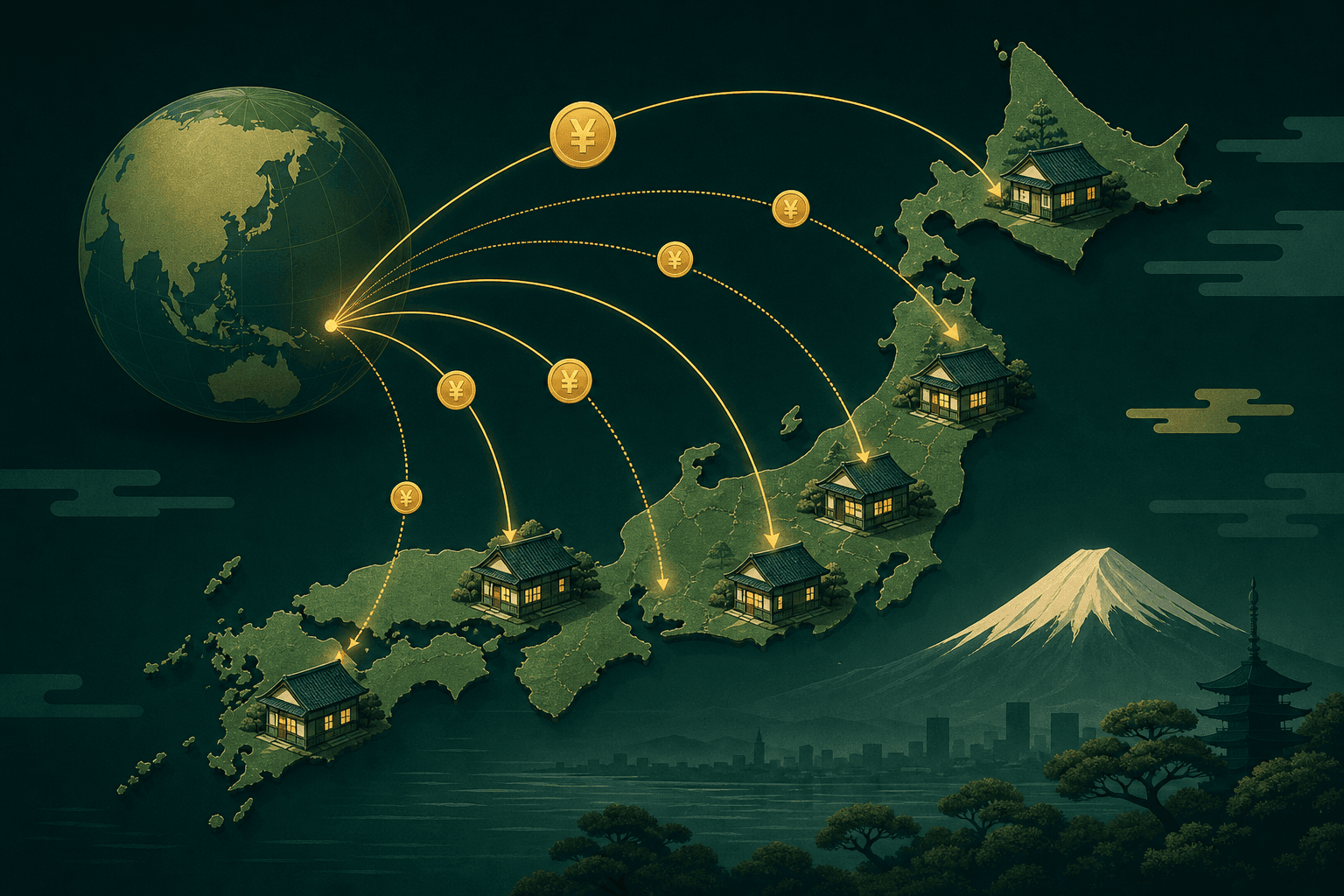
Foreign minpaku capital in Japan in 2026 is not spread evenly — it clusters into four distinct plays: 365-day city cash flow (Osaka, then Tokyo's Ota-ku), ski-season trophy income (Niseko and its satellites), island and coastal lifestyle-yield (Okinawa, Kyoto machiya), and cheap akiya conversions. Where a buyer lands usually says more about their nationality, currency, and risk appetite than about the raw yield numbers.
This is a demand-side map, not a profitability ranking. If you want areas scored on net yield, that lives in our most profitable minpaku areas ranking and the city-by-city ROI analysis. Here we answer a different question: where is foreign money actually going, who is spending it, and what is drawing them there — so you can see which crowd you'd be buying alongside before you commit.
TL;DR
- The weak yen is the single biggest driver. For a dollar, Singapore-dollar, or HKD buyer, Japanese property and its running costs are ~30% cheaper than they were in 2020, which reframes even a modest minpaku yield as attractive.
- Osaka is the institutional-grade play because of 特区民泊 365-day zones — it attracts the most repeat and multi-unit foreign operators. See the 180-day cap and 365-day paths guide.
- Niseko is the trophy-income play — the clearest case where resort minpaku beats long-term rental, and where Australian, Singaporean, Hong Kong and increasingly American money concentrates.
- Okinawa and the islands are the lifestyle-yield play — year-round warmth, domestic + inbound demand, but thin management supply and real coastal risk.
- Akiya conversions are the value play — cheap entry, but only a minority of vacant homes actually qualify for legal short-term rental.
- Popularity is not the same as profitability. Several of the most searched areas are among the hardest to operate legally.
Why foreign minpaku demand is rising in 2026
Three structural forces overlap right now, and they reinforce each other.
The yen. A persistently weak yen means foreign buyers convert into more square meters, and — just as important — their yen-denominated operating costs (management, cleaning, utilities, tax) are cheap in home-currency terms. A 6% net yield in yen feels very different to a USD investor whose entry cost fell by roughly a third versus 2020.
Inbound tourism. Japan's visitor numbers have fully recovered and pushed to record territory, with demand spread well beyond Tokyo–Kyoto–Osaka into ski country, Okinawa, and regional cities. More nights of demand across more of the calendar is exactly what a short-term rental needs.
A maturing operator ecosystem. English-capable 住宅宿泊管理業者 (management companies), remote check-in technology, and platforms that remit to overseas accounts have made it realistic to own from abroad. The practical work is still real — see the reality of running a minpaku — but the friction that used to keep non-residents out has fallen.
The caution that belongs next to all of this: demand strength does not override regulation. Japan's minpaku rules cap most properties at 180 days and roughly 99% of condo bylaws prohibit short-term rental outright. The areas below are popular despite — or, in Osaka's case, because of — how that regulation lands locally.
The four foreign-buyer plays, mapped
Play 1 — City cash flow: Osaka first, then Tokyo's Ota-ku
This is where the most disciplined, repeat foreign capital goes, and the reason is structural rather than emotional: 特区民泊 special zones allow 365-day operation. Osaka City is designated city-wide, which removes the single biggest yield constraint in Japanese short-term rental. That one fact makes Osaka the default entry point for foreign investors who treat minpaku as a business rather than a holiday home — and the natural base for anyone scaling to multiple units.
Tokyo is the opposite story: enormous demand, but only Ota-ku carries 特区民泊 designation (helped by its Haneda Airport adjacency). The other 22 wards sit under the 180-day cap, often with additional local restrictions. Foreign buyers still chase central Tokyo for capital preservation, but as a minpaku play Tokyo is far more constrained than its tourist numbers suggest.
Who buys here: Singapore, Hong Kong, Chinese, and increasingly US operators looking for repeatable cash flow rather than a lifestyle asset.
View real transaction prices, price trends, and investment analysis for Osaka Namba / Shinsaibashi based on MLIT government data.
Explore Osaka Namba / Shinsaibashi Data →Play 2 — Ski-season trophy income: Niseko and its satellites
Niseko is the clearest case in Japan where resort minpaku genuinely out-earns a long-term lease — driven by world-class powder, a ~90–100 day winter peak, and nightly rates that run multiples of a comparable city rate. It is also where the most concentrated foreign resort capital sits: historically Australian, then Singaporean and Hong Kong, and now a rising American share.
As Niseko/Kutchan prices have climbed, that demand has spilled into satellites — Hakuba, Furano, and the earlier-cycle Myoko and Furano frontier. The trade-off is seasonality and resort-grade costs (snow removal, remote management), which we cover in the resort Airbnb investment guide and, from a risk angle, in mountain & ski minpaku risks.
Who buys here: lifestyle-plus-yield buyers who also want personal ski use — Australia, Singapore, Hong Kong, USA.
View real transaction prices, price trends, and investment analysis for Niseko / Kutchan based on MLIT government data.
Explore Niseko / Kutchan Data →Play 3 — Island & coastal lifestyle-yield: Okinawa and Kyoto machiya
Okinawa is Japan's warm-weather counterweight to the ski trade: year-round demand, strong domestic and inbound flows, and a genuine lifestyle pull. Naha, Chatan (American Village), the Onna resort coast, and the outer islands of Ishigaki and Miyako all attract foreign interest. Kyoto sits in a related bucket — the machiya conversion is one of the most emotionally desirable minpaku assets in Japan, though Kyoto's licensing and neighborhood rules are among the country's strictest.
The honest caveats here are operational and physical: management supply on the outer islands is thin, and coastal property carries typhoon, salt-corrosion, flood and (in places) tsunami exposure that belongs in your underwriting — see coastal & island minpaku risks and the broader coastal tsunami-risk guide.
Who buys here: lifestyle-led buyers, second-home-plus-rental owners, and a meaningful share of domestic Japanese capital they'll be competing with.
View real transaction prices, price trends, and investment analysis for Okinawa Chatan / American Village based on MLIT government data.
Explore Okinawa Chatan / American Village Data →Play 4 — Value conversions: akiya as minpaku
At the cheap end, foreign buyers are drawn to Japan's ~9 million vacant homes as low-entry conversion projects. The appeal is obvious — headline prices in the low millions of yen. The reality is that only a minority of akiya actually qualify for legal short-term rental once you account for zoning, fire code, structural condition, and renovation cost. We break down exactly which vacant homes make the cut in akiya for minpaku: which vacant homes qualify, with cost context in akiya renovation costs by region.
Who buys here: budget-first, hands-on, project-oriented buyers — often USA and Europe — comfortable with renovation risk.
Free due-diligence checklist (PDF)
Before you trust a 16% yield — run the 7-layer check
The due-diligence checklist we built investigating a real high-yield listing in Japan — including the land-registry check that changed the deal. Free PDF, sent to your inbox.
No spam. Unsubscribe anytime in any email.
How this crosses with Japan's most-read investment stories
The most useful way to read the minpaku map is through the lens of the trends already pulling foreign capital into Japan — the same stories driving our most-read articles. The overlap is where the interesting entry points sit:
- Semiconductor boom towns × minpaku. The Chitose/Hokkaido semiconductor boom and the TSMC Kumamoto lessons are creating business-travel and relocation demand — a different, steadier demand profile than tourist minpaku, and worth understanding before assuming leisure occupancy.
- Ski-cycle timing × resort minpaku. If you're weighing the ski resort property comparison, the minpaku income case is what turns a holiday chalet into an investment — but only where the season and licence line up.
- Coastal risk × island minpaku. The earthquake and tsunami risk analysis is not a reason to avoid the coast; it's the reason to price insurance and elevation into island minpaku correctly.
- Weak-yen buying × country guides. How this all looks from your side depends on where you're wiring money from — see the guides for US, Singapore, and China investors.
Popular ≠ profitable: three honest warnings
- Kyoto is the most desired machiya market and one of the hardest to operate. Strict ordinances, neighborhood pushback, and fire-code retrofits on old wooden structures mean the dream asset is often the hardest licence.
- Tokyo's tourist volume is a trap for first-time minpaku buyers. Outside Ota-ku you're capped at 180 days, and condo bylaws almost always prohibit short-term rental — so the "obvious" city is one of the worst structural fits.
- Island and remote demand is real but management is thin. A high nightly rate on Ishigaki means little if you cannot secure a reliable local operator for turnovers and 24/7 response.
The through-line: chase the structure (365-day operability, a management base, and defensible demand), not the postcard.
From "where" to "whether it works for you"
A demand map tells you where the crowd is. It does not tell you whether a specific property clears after 20.42% non-resident withholding, 15–25% management, cleaning, vacancy, and the local operating-day ceiling. That's the next layer:
- Confirm the legal ceiling for your target area — 365-day, capped, or effectively off-limits — via the minpaku rules guide and 180-day cap paths.
- Run the net-yield math for that specific city with the minpaku ROI by city framework.
- Understand the operating workload before assuming passive income — see the real work of running a minpaku.
- Validate a specific property with minpaku-specific due diligence — our minpaku due diligence checklist.
Weighing a specific area or property? Our Price Check Report ($49) reviews an area's MLIT transaction history and regulatory context so you can sanity-check the demand story against the numbers before committing capital. Explore live area data any time on the Locations pages.
Frequently Asked Questions
Where are foreign investors buying the most minpaku in Japan in 2026?
The heaviest, most repeat foreign minpaku capital concentrates in Osaka — because its city-wide 特区民泊 designation allows legal 365-day operation, the single biggest structural advantage in Japanese short-term rental. Niseko (ski-season trophy income), Okinawa and its islands (year-round lifestyle-yield), Kyoto (machiya conversions), and Tokyo's Ota-ku round out the main hotspots. Cheap akiya conversions attract a separate, budget-first crowd nationwide.
Why is foreign demand for Japanese minpaku growing?
Three forces overlap: a persistently weak yen that makes both entry prices and yen-denominated operating costs cheap in home-currency terms; record inbound tourism that has spread demand beyond the big three cities; and a maturing ecosystem of English-capable management companies, remote check-in technology, and platforms that pay to overseas accounts, which makes remote ownership realistic.
Which nationalities buy minpaku where in Japan?
Broad patterns rather than rules: Singapore, Hong Kong, Chinese and increasingly US investors favor Osaka and Tokyo city cash-flow plays; Australian, Singaporean, Hong Kong and rising American money concentrates in Niseko ski country; lifestyle-led buyers (plus significant domestic Japanese capital) compete in Okinawa and the islands; and budget-first, project-oriented US and European buyers dominate akiya conversions.
Is the most popular minpaku area also the most profitable?
No. Popularity and profitability often diverge. Kyoto is among the most desired machiya markets but has some of Japan's strictest short-term rental rules. Tokyo has huge tourist volume but caps most properties at 180 days outside Ota-ku, with condo bylaws usually prohibiting Airbnb entirely. Osaka's advantage is structural (365-day zones), not merely popularity. Always confirm legal operating days and net yield before treating "popular" as "profitable."
Can a non-resident foreigner buy and run a minpaku in these areas?
Yes. There is no citizenship or residency restriction on owning Japanese property, and non-residents can operate short-term rentals provided they designate a qualifying local management contact (typically a licensed 住宅宿泊管理業者) reachable 24/7 and appoint a tax administrator (納税管理人). The practical constraint is operational — securing reliable local management — which is easier in mature markets like Osaka and Niseko than on remote islands.
Related Articles
- Most Profitable Minpaku / Airbnb Areas in Japan (2026, Ranked) →
- Minpaku ROI 2026: Realistic Yields by Japanese City →
- Japan Short-Term Rental (Minpaku) Rules 2026 →
- Mountain & Ski Minpaku: Best Areas and the Risks →
- Coastal & Island Minpaku: Best Areas and Coastal Risks →
- Resort Airbnb Investment in Japan →
- Akiya for Minpaku 2026: Which Vacant Homes Qualify →
- Scaling to Multiple Minpaku: A Foreign Investor's Roadmap →
Disclaimer
This article describes general market and demand patterns in Japan's short-term rental sector as of 2026 and is provided for information only. It is not investment, legal, or tax advice. Buyer-nationality patterns are broad generalizations, not data on any individual transaction. Regulations, special-zone designations, and market conditions change; always verify current rules with the relevant municipality and consult qualified Japanese professionals before acquiring or operating a property.